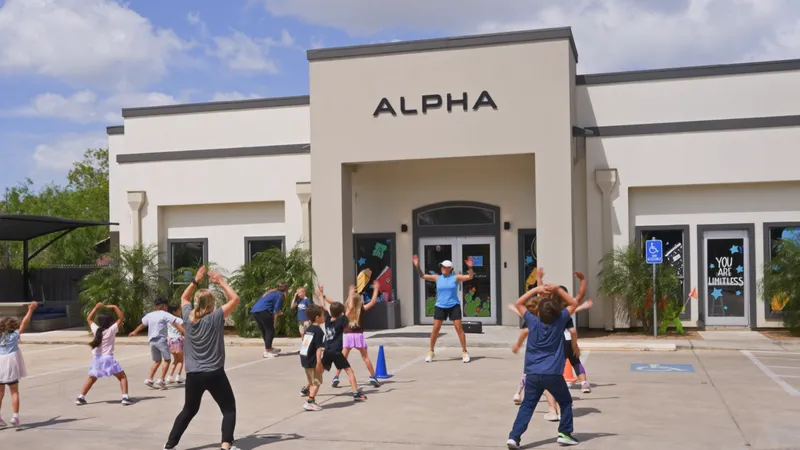
An average Bay Area Parents we are aware of are spending $1,500–2,500 a month on after-school programs — on top of $40,000-$55,000 for private education. If you are weighing Alpha against established local alternatives, our complete Bay Area private school list covers the top options for gifted, art-focused, or nerodivergent kids, while families tracking multi-city expansions can jump directly to our breakdowns for Alpha Austin, Miami, and New York
The Royal Baseline
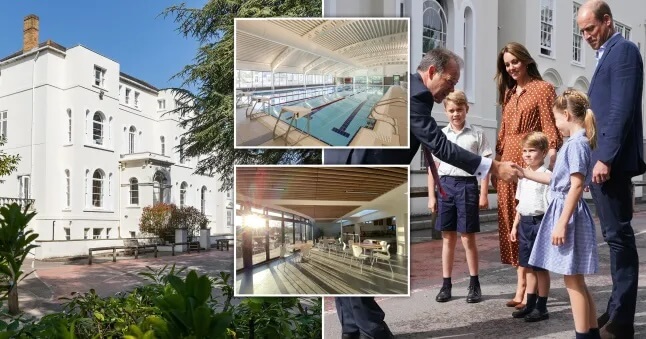
Lambrook School in Berkshire, England — the co-educational prep school where the future King of UK Prince George attended — runs $25,000 to $43,600 a year.
For that, families get 52 acres of English countryside, a nine-hole golf course, a cricket pitch, a performing arts centre, a working farm, and credentialed teachers who have been placing pupils at Eton for generations - plus the multi-generational network that prepares your kids for the modern equivalent of the debutante ball circuit.
The Storefront Reality Check
For that price, royal families get 52 acres of English countryside, a nine-hole golf course, a cricket pitch, a performing arts centre, a working farm, and legendary credentialed teachers who have been placing pupils at Eton and Marlborough for generations.
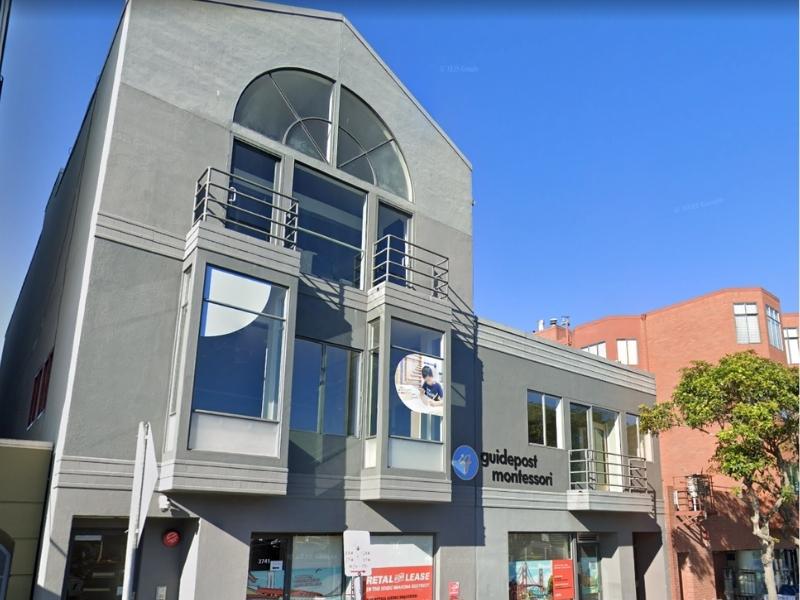
By contrast, Alpha School San Francisco currently has between 25 and 30 students total. It operates out of a tight, leased commercial storefront in the Marina District. When kids need outdoor time, they take a walk to Moscone Park or the Marina Green.
That is not automatically a dealbreaker — the two schools represent completely different philosophies about the future of learning. But it is exactly the right baseline frame to hold in your head while you evaluate the premium price.
For the full breakdown of how the 2-hour learning model actually works, the documented parent complaints, the software loop problem, and what WIRED and 404 Media found inside Alpha's operations, read our full Alpha School investigative review. This post is your explicit financial and local Bay Area reality check.
Alpha School San Francisco Reviews
The SF campus launched in Fall 2025, opening with just 10 actively enrolled students according to The Guardian's investigation — with 25 families having put down initial deposits, but only 10 physically attending on day one.
Enrollment has since grown to 25–30 students across grades K–10, per Niche and Spring 2026 coverage. At this hyper-small micro-scale, every single review carries outsized weight — and the parent feedback splits sharply.
🟢 What the Thriving Families Appreciate
Parents who are genuinely happy with their choice describe an incredible lifestyle and pacing shift for their households:
Renewed Enthusiasm:
Kids who previously dreaded school are now asking to go back even during holiday breaks. This perfectly mirrors the early Astral Codex Ten parent reviews and Austin Substack accounts. For a child who suffered through traditional school bureaucracy, this shift is massive.
Pure Academic Pacing:
Multiple SF parents report their kids advancing through math and reading modules at double or triple the expected rate of standard local classrooms. To see how these algorithmic software loops function under the hood, you can read more about the Alpha curriculum and its MAP data here.
Logistical Consolidation:
The afternoon programming genuinely delivers. Built-in coordination for bouldering at Benchmark Climbing Gym, public speaking workshops, and outdoor biking replaces two or three separate after-school pickups.
High Guide Proximity:
1:6 ratio offers a lot more that a traditional teacher with 25 kids never could.
🔴 What the Skeptical Families Flag
Families who have withdrawn or hold deep reservations describe an operational experience that feels deeply compromised:
The Software Loop Problem:
When a child hits a genuine conceptual wall, the software replays the same explanation — and guides aren't credentialed subject specialists who can fill that gap. This is documented independently by WIRED (October 2025), 404 Media (February 2026), and a detailed four-part Substack series by a Brownsville parent (mid-2025). All three describe the same pattern: the dashboard stays green while the gap quietly grows. Full details in our investigative review.
The Writing Support Deficit:
Parents describe the humanities framework as incredibly thin. AlphaWrite provides automated prompts but limited iterative feedback on voice, argument structure, or deep revision — the exact skills UC application essays demand.
The 25-Student Bubble:
A school of this micro-size simply cannot build the robust peer network, competitive academic culture, or diverse social depth that a larger campus produces naturally.
Alpha School Tuition Cost
To determine if the value proposition holds up, we have to look closely at what an annual alpha school tuition cost of $75,000 actually covers under the hood.
The Baseline Inclusions
- The morning block, including roughly two hours of active, adaptive academic software supervised by non-credentialed Guides
- Active access to TimeBack — Alpha's proprietary software engine covering AlphaRead, AlphaWrite, and AlphaMath Fluency (live beta as of mid-2026)
- Coordination and execution of afternoon life skills, local sports excursions, and venture blocks run by on-site facilitators
The Out-of-Pocket Exclusions
- Transportation: No dedicated busing or shuttle infrastructure
- Specialist Intervention: If your child hits a conceptual wall the adaptive software cannot resolve, outside subject-matter tutoring falls entirely on the family. Worth noting: WIRED's investigation found Alpha's remote coaching staff were largely based in the Philippines and Colombia — not local credentialed specialists.
The Enrichment Reality: Recreational vs. Competitive
There is an underlying friction that veterans of youth sports and arts programs know well: when a child signs up for swimming, fencing, gymnastics, or martial arts through a general school partnership, the vendor almost always runs a basic, recreational track. As we were told
Parents quickly realize that school-coordinated enrichment is built for broad exposure, not high-tier mastery.
If your child discovers a true competitive passion, you will still end up driving them to dedicated off-campus training centers after hours.
However, letting kids naturally explore diverse fields "after two hours of core learning" keeps them highly engaged throughout the afternoon. It beats the baseline alternative: sitting trapped in a standard six-hour classroom getting board.
The Timeback Beta Reality
Co-founder Joe Liemandt has frequently described TimeBack as a $100M+ operating system engineered to scale the future of global education. For families enrolled today, the software platform aggregates AlphaRead and AlphaWrite, functioning primarily as a background data layer that tracks pacing, manages daily goals, and triggers gamified incentive charts. [1, 2, 3, 4]
The advanced, conversational AI tutoring that leadership paints as their long-term vision is still actively being engineered. One detail the founders emphasize is that TimeBack is completely chatbot-free. They openly tested conversational bots and scrapped them after students immediately figured out how to use them to clear levels dishonestly. Today, the software acts as an algorithmic engine operating quietly in the background, rather than an interactive tutor. [1]
While TimeBack has expanded to power Alpha Anywhere (the $833/month home setup) and anchors their expanding network of specialized sports and gifted charter schools, the infrastructure remains explicitly in live beta. [1, 2]. Some Alpha parents trasnferred to the typical private schools from Alpha shared with us -
For Bay Area families paying a steep premium, this means your children are effectively serving as the foundational testers. Much like early Tesla buyers who paid a luxury premium to fund a prototype roadmap, you are not buying a finished, flawless product.
Alpha School Cost
When evaluating the baseline alpha school cost, it helps to stack it directly against the established Bay Area options.
The financial paradox is stark. Alpha sits at the absolute top of the local pricing matrix while being the only premium option completely stripped of credentialed faculty, traditional physical campuses, and a verifiable long-term university placement track record.
To see how these schools compare on what they actually build in a child — writing depth, emotional intelligence, and grit — read our Alpha vs. Bay Area AI schools comparison.
For the complete landscape across all price points for gifted, builder, art-focused, or neurodivergent children, our comprehensive Bay Area Private Schools Guide covers every top local option.
For homeschooling families, our Alpha Anywhere and homeschool alternatives review breaks down the full stack.
Alpha School Ratings
Why the Numbers are Misleading
Parents hunting for verified alpha school ratings quickly run into an analytical wall. Niche currently shows a perfect 5.0 for Alpha SF — but you have to look at the sample size behind that number.
The First-Year Selection Bias
That 5.0 score represents an incredibly small group of early adopters who voluntarily chose an unconventional model and are highly incentivized to root for it to work. That is first-year enthusiasm, not an objective institutional track record. The early Austin Substack reviews and Astral Codex Ten accounts showed the exact same honeymoon pattern in year one, right before longer-term curriculum complexities began to emerge.
To see past the initial hype, you have to look directly at the academic metrics and read our deeper look into Alpha's own MAP data and curriculum legitimacy here.
The No-Financial-Aid Constraint
Alpha's SF campus cannot currently offer financial aid or tuition assistance.
As The Guardian reported directly, because the school runs an experimental cohort of just 25–30 students inside a leased commercial space, the campus has no permanent endowment, no alumni donation pool, and no capacity for structural subsidies. Your $75,000 is not buying your way into an established, resilient institution. It is directly funding a lean, venture-backed experimental startup.
Look at it this way -
Elite legacy schools aggressively recruit and pay for top-performing scholarship kids to artificially juice their college placement numbers.
Alpha's raw student data is actually a level playing field. It strips away the standard private school game.
Here, you see the real results.
The New Bay Area Campuses: The Storefront School
The demand is undenabile. Alpha School opened 10 new campuses, including locations in downtown San Francisco, Orange County, and Santa Barbara. For families researching how Alpha's model plays out differently in Austin, Miami, and New York — where tuition ranges from $40K to $65K for the same software platform — our Alpha School Austin, New York, and Miami review maps the full picture.
MacKenzie Price confirmed that Alpha's Palo Alto campus expansion was waitlisted when we spoke in Palo Alto in April 2026—months ahead of its official launch, and plan to open a Marin school.
Alpha is an aggressive pioneer of the "Unbundled Storefront School" model. They completely reject the heavy real estate overhead of traditional prep academies. A look at their new regional addresses reveals exactly how this lean corporate strategy plays out on the ground:
📍 Palo Alto
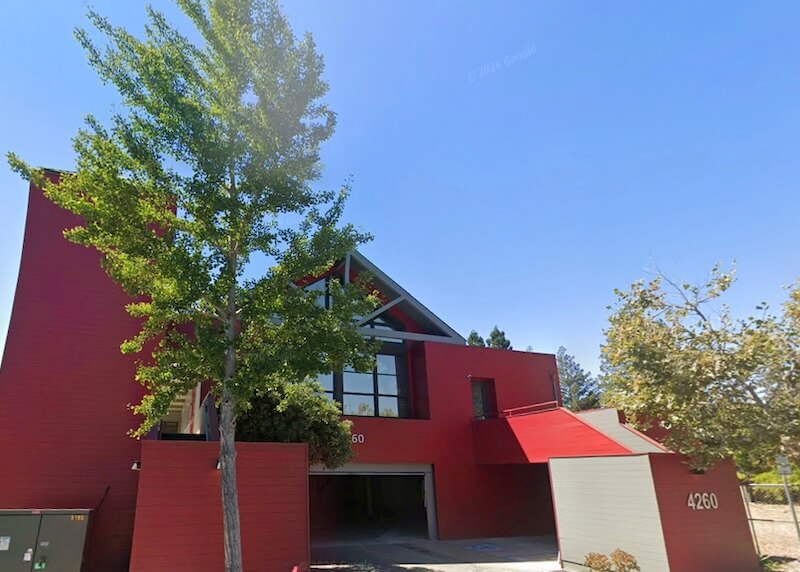
True to its asset-light startup model, Alpha’s Palo Alto location is a commercial lease rather than a property purchase. Operating out of a retail-faced space at 4260 El Camino Real, the footprint is small—roughly 5,000 to 7,000 square feet. Different from the sprawling courtyards, sport fields, or infrastructure of legacy Bay Area privatre schools - or public.
📍 Piedmont
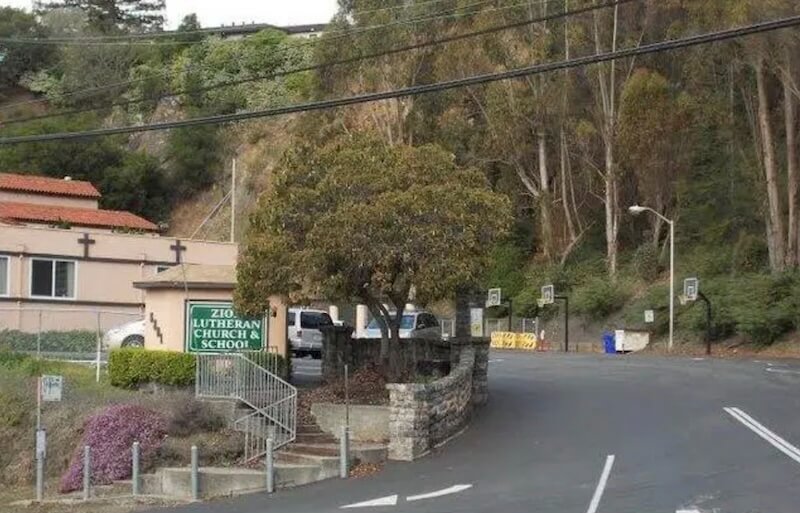
Before Alpha's acquisition, this space housed Academia de Mi Abuela, a local Spanish-immersion preschool. The building sits inside the physical real estate footprint of Zion Lutheran Church. Alpha has leased a neighborhood childhood unit and retrofitted it with digital adaptive screens.
The Physical Health Trade-off: Screen Proximity and Distance Vision
While both spaces will become functional learning environments, they will not become campuses in any traditional sense — no sports fields, no wet labs, no dedicated green spaces.
There is one biological reality no software upgrade can replace: children's eyes need distance. Pediatric ophthalmology research consistently links prolonged close-screen focus without regular distance-viewing breaks to rapid myopia progression in school-age children.
This is a well-documented concern in Chinese-American communities in particular, where rates of childhood myopia are already statistically elevated. A school environment where the entire academic block happens on laptops, indoors, inside a converted real estate office, introduces a real physical health consideration — not just an amenity complaint.
For context on how Bay Area private schools with actual campuses compare, see our complete Top Bay Area private schools guide.
What Chinese-American Families Are Saying on Xiaohongshu
The most candid, high-signal discussions regarding Alpha's value proposition aren't happening on English-language Reddit threads. They are happening on Xiaohongshu (小红书).
The initial cultural appeal among local Chinese-American parents is instant and completely genuine: "终于有学校认真对待STEM了" ("Finally a school that takes STEM seriously"). The promise of stripping away administrative bureaucracy, maximizing algorithmic efficiency, and letting a child accelerate through mathematics speaks directly to high-achievement family values.
To their credit, Alpha publishes their own independent MAP test data publicly — you can review the 2025 NWEA MAP Results and their mid-year report card directly. For full context on what those numbers mean — including the three structural filters that shape them — see our Alpha School curriculum and legitimacy review.
However, when you look past the initial excitement, three cultural and practical anxieties surface repeatedly:
1. The UC Admissions Essay Problem
Admissions loops at UC Berkeley and UCLA live and die on non-formulaic, highly sophisticated human writing — personal statements, rhetorical voice, and argumentative essays. The Xiaohongshu community openly acknowledges that deep, persuasive writing is a massive structural deficit in a software-first environment.
2. The 25-Peer Social Graph Deficit
The elite social capital and lifelong peer networks built at an institution like Harker compound steadily over a twelve-year horizon. Bay Area families think in multi-generational timelines about social graphs, and Alpha's 25–30-student storefront micro-campuses simply cannot replicate that systemic institutional network.
3. The Extrinsic Trap of the Reward Economy
This is a profound behavioral concern raised frequently on Xiaohongshu. It brings to mind the famous cautionary story of a Chinese child prodigy who was pushed to clear academic milestones via rigid, transactional reward tracking. He entered university at 10 and graduate school at 13, but by his late twenties, his internal motivation completely shattered. He now publicly advocates for total "lying flat" (tang ping), completely unmotivated and dependent on his parents.
Local parents are rightly asking: when you train a child's brain to constantly ask "How many Alpha Bucks is this worth?" before executing a task, do you permanently break their intrinsic love for learning over a ten-year horizon?
While Mackenzie Price argues that kids naturally outgrow the token economy after a year or two as pure curiosity takes over, it remains a critical psychological question you must monitor closely. We go deeper on the motivation research in our investigative review.
College Outcomes
When assessing Alpha's track record, the most widely cited college outcome is Kate Liemandt — co-founder Joe Liemandt's daughter, who scored a perfect 1600 on the SAT at Alpha Austin and went on to Stanford, writing about her experience in the Austin Scholar newsletter. Co-founder Mackenzie Price's daughters have gone on to Vanderbilt and Parsons School of Design. These are phenomenal achievements worth noting.
The Founder's Family Sample Size
They are outcomes pulled directly from the founders' own immediate families and the school's earliest, most heavily resourced cohorts — not independent population data.
The Hidden Selection Bias Filter
Here is the selection bias problem analytically-minded Bay Area parents must factor in: the families currently enrolled at Alpha SF include prominent venture capitalists, tech founders, and high-earning executives. These households produce children who frequently gain access to elite universities regardless of where they attend school — driven by parental networks, high-end private supplemental tutoring, and outside resources entirely independent of the learning platform.
When you look at Alpha's broader student destinations across all historical campuses, Niche's tracking of Alpha High Austin shows the vast majority of documented placements at regional flagships like UT Austin — not a sweeping wave of Ivy League acceptances.
Alpha has repeatedly stated its intention to publish a full, audited university matriculation record. As of May 2026, that comprehensive document does not exist publicly.
AIFunLab Verdict
At $75,000 you are enrolling as an early adopter inside a 25–30 student cohort in a leased Marina storefront — no financial aid, no credentialed faculty, an unproven collegiate track record, and a core software platform still in live beta. The educational vision may eventually be proven right. But unlike most Silicon Valley software bets, this one has your child sitting directly in the middle of it.
Best fit: Self-directed learners whose families can absorb the cost without financial pressure and are genuinely aligned with an experimental, software-first model.
Not recommended if: College pipeline clarity, humanities depth, financial aid eligibility, or a proven institutional peer network are priorities.
Take a quick quiz and get recommendations for Bay Area private schools and STEM programs that fit your child.
Alpha School Campuses: San Francisco, Palo Alto, & Piedmont Comparison
How does Alpha School SF compare to Harker and Nueva on cost and campus?
Alpha School matches the premium tuition pricing of elite Bay Area institutions like Harker and Nueva, but trades their massive physical campuses for hyper-focused urban tech spaces. While Harker and Nueva feature sprawling suburban complexes with state-of-the-art labs and sports arenas, Alpha utilizes decentralized, tech-forward micro-campuses. Families choose Alpha over traditional elite campuses specifically to prioritize software-driven personalization over physical campus footprint.
Is the high cost of Alpha School in the Bay Area worth the tuition?
Alpha School’s tuition is worth the investment for self-motivated students who thrive under custom software metrics and rapid, non-linear academic acceleration. The cost pays directly for a 1-on-1 progress pacing model that allows students to finish standard coursework by noon. However, for families prioritizing comprehensive peer networks, large-group social dynamics, or traditional extracurricular activities, the premium cost may not be justified.
How does Alpha School replace traditional teacher-led lectures?
Alpha School replaces standard lectures by automating core academics through adaptive software in the morning, freeing afternoons for hands-on life skills workshops. From 8:30 AM to noon, students complete hyper-personalized math, reading, and science modules independently. The remaining school hours are dedicated entirely to peer-led public speaking, financial literacy simulations, and dynamic team building, shifting the traditional teacher's role from a lecturer to an active behavioral coach.
References
- Alpha School: The $75K Hype That Failed Some Parents—and Kept Others by us
- Astral Codex Ten — 12-month parent review and longitudinal observations
- The Zvi (Substack) — Economic and incentive analysis of Alpha’s model
- Substack (multiple authors) — Brownsville parent’s four-part firsthand review, See links in the article.
- Hard Fork Podcast (New York Times) — Founder interviews and AI-in-education context
- Newsweek — Reporting on Alpha’s expansion and teaching model, 1 and 2
- Niche.com — Parent reviews (noting strong self-selection bias)
- Reddit — r/bayarea and r/sanfrancisco parent discussion threads
- ABC7 News — Bay Area expansion coverage

Derivatives & startup experience across 3 continents, including China. Elementary school mom to one very active kid. LSE MSc.



%20(300%20x%20250%20px)%20(1).avif)
%20(300%20x%20250%20px)%20(2)%202.avif)



-min.avif)