
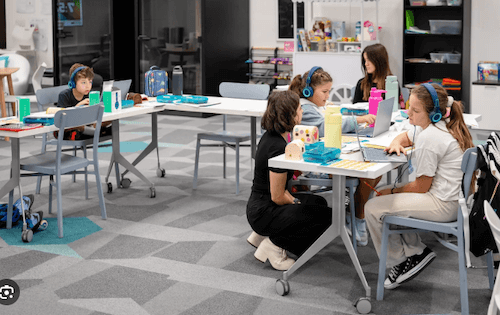
Stanford undergraduate tuition is about $68,000 while Alpha School's San Francisco campus charges $75,000 a year! Starting with kindergarten — and a K-through-high-school run comes to roughly $1 million.
For that, you'd expect something spectacular. All three Bay Area Alpha sites are leased commercial units - with no gym, no field and no lab.
We spoke directly with co-founder MacKenzie Price, reviewed the major independent investigations, and read Alpha's published MAP data alongside what sits behind it.
Alpha School Reviews: What $75K Actually Buys Bay Area Families
Behind the tuition sits Alpha Anywhere — the same TimeBack software, packaged for homeschoolers at $833 a month. For campus-by-campus tuition see our SF, Palo Alto and Piedmont breakdown; for a side-by-side against Acton, Nueva and Harker, our comparison. Every other serious option is in our Bay Area private school list.
How Alpha School Works (The 2-Hour Model)
It compresses all core academics into a highly focused morning block, then spend the afternoon on real-world skills.
The Morning Block (roughly 8:30 AM–12:30 PM):
Your child works through adaptive mastery software at their own pace. Adults in the room are called "Guides"—not teachers—and they circulate at a 5-to-1 student ratio. When a kid gets a concept right consistently, the software moves them forward. When they get stuck, it loops back.
The Afternoon Block (Life Skills):
This is where Alpha genuinely stands out. High schoolers participate in AlphaX—launching real business ventures, building apps, podcasting, and pitching to real audiences. Younger students have sports, entrepreneurship workshops, and public speaking.
Two things to know
Some parents cited "two hours" of learning is realistically three to four—still better than traditional school. Founder Mackenzie Price confirmed their internal MAP data shows effective learning time comes in under two hours. Her team promised to send us their raw data files to independently audit;
as of August 2026, those documents still haven't arrived — three months after they were promised
Alpha's leadership is also clear that the "AI" is not what most parents picture. They've launched their own proprietary platform called TimeBack, which handles Alpha Read and Alpha Write—not a conversational chatbot. Beyond TimeBack, their core math application is standard adaptive practice software, the same fundamental category tech-forward schools have used for a decade.
Trying to figure out if $75K is truly defensible compared to other local options? We broke down the exact math in our Alpha School tuition ROI for Bay Area parents.
Nonetheless, this pivot toward a digital-first childhood isn't without its risks, as seen in the broader gaming world—read why 3,000 families are now seeking justice against Roblox for more on the hidden dangers of unmonitored digital platforms, and why Denmark led European countries to ban the digital learning. Ultimately, parents must decide if they are ready to trade traditional mentorship for a high-output, software-driven future.
Alpha School Reviews and Complaints: What Reddit and Parent Forums Say
The most useful research on a non-traditional school isn't on their official channels. It's inside independent parent forums. This pattern is documented - here's the deep dive with Alpha's own MAP data.
Illusion of Competence
The biggest open secret among families tracking this model: parents often learn their child is falling behind months after the damage is done. A parent on Reddit's r/bayarea:
"I was told my daughter wasn't reading instructions carefully. I sat down with her at home. The instructions assumed she knew what a denominator was—she didn't. No one had ever taught her the base concept. The software just kept looping the exact same automated explanation over and over."
When a child hits a conceptual wall that requires a human to explain it differently—not replay a video or serve up a parallel problem—the system breaks. Guides are facilitators, not subject-matter teachers. Multiple parents describe guides who gave incorrect methods just to push a student past a stuck point and keep their dashboard metrics looking clean.
The $20 App Paradox and the Fired School
On parent forums, the loudest reviews and complaints focus on a terrifying administrative blind spot: parents often have no idea their child is falling behind until it is far too late.
For years, Alpha's primary math engine relied heavily on IXL—a platform any parent can buy for $20 a month. In a formal statement to WIRED, IXL clarified their platform "is not intended—and we do not recommend its use—as a replacement for trained, caring teachers." The software vendor terminated the school for misusing the product.
Alpha has since moved to Math Academy, an excellent platform any parent can purchase independently for $49 a month and launched its own TimeBack platform to run their Alpha Read and Alpha Write tracks. But switching applications doesn't solve the core issues when adaptive softwares replacing teachers.
Software Loop Trap
When they do face a genuine conceptual hurdle, the algorithm hits a dead end—unable to explain the concept in a fresh way, it traps the child in a frustrating, repetitive software loop. Or kids intentionally select the easiest games over and over just to rack up points.
This isn't uniquely an Alpha issue; it is the fundamental flaw of unsupervised adaptive tech across the board.
The Gaming Problem: Turning Learning into a Transaction
Alpha runs on "Alpha Bucks"—kids earn roughly $1–2 per day for hitting speed and progress targets. The research behind this is real: Harvard economist Roland Fryer found that paying kids for specific, executable behaviors drives short-term output. Mackenzie Price told us that after a year or two, most kids naturally outgrow the bucks - if the kids are interested in the subjects enough.
One Alpha parent described the arc:
"The first month, my daughter was thrilled to earn enough for a book. By month four, she was negotiating for bigger prizes."
Another:
"My son started asking 'How many bucks is this worth?' before doing anything. He stopped caring about understanding—he just wanted the points."
On r/AustinParents, families whose kids are thriving describe exactly what Alpha promises—children who were bored and disengaged now racing through material autonomously.
The split is entirely consistent across forums: kids who already possess high internal motivation tend to accelerate; kids who need a human relationship to build those qualities tend to fall into the blind spot or leave.
Alpha School Tuition by Campus (2026–27)
Is $75K the going rate?
It isn't. To compare your regional options, check out our complete list of private schools in the Bay Area, browse our specific guide on AI-first schools in the Bay Area, or explore our Alpha Anywhere and TimeBack review to evaluate their remote at-home model.
The Alpha School Controversy: What the WIRED and 404Media Investigations Found
Two major investigations—WIRED's October 2025 deep dive and 404media's February 2026 report based on leaked internal documents—surfaced details that don't come up on campus tours.
The Academic Coaching Setup:
When students get stuck and book a coaching call, WIRED discovered that 27 of 31 coaches listed for 2023–24 were remote workers in the Philippines and Colombia, employed by co-founder Joe Liemandt's other corporate ventures—not credentialed teachers or subject specialists. [1, 2] For a $75,000 local price premium, parents expect local, face-to-face expert mentorship.
Home Webcam Monitoring (Defaulted On):
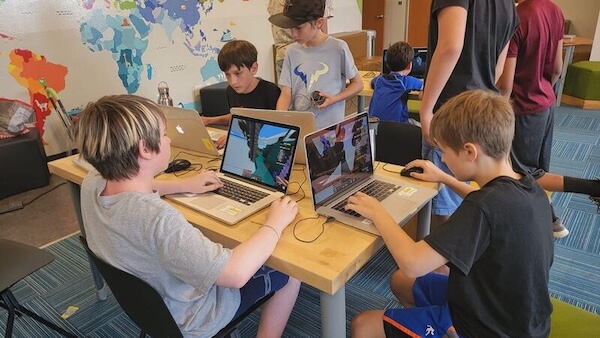
Screen recording, keyboard tracking, and eye-tracking run on campus. When your child takes the device home, webcam monitoring continues unless a parent manually opts out. One student received a behavioral flag while sitting in her pajamas in her bedroom, talking to her younger sister.
A student quoted in the 404media piece put it plainly: "We are real people, not machines."
The Food Incident:
WIRED reported a 9-year-old with a doctor's note requiring snacks was told she hadn't earned them until she hit her learning metrics. Mackenzie disputes it, saying it came from a mother with a prior conflict with co-founder Joe Liedtmandt. The mother is named directly in the piece—local families can weigh both accounts.
AI Lesson Quality:
The 404media investigation found Alpha's AI-generated lesson plans have been flagged internally as sometimes doing "more harm than good," and that the school was scraping training data from other platforms like Khan Academy without permission. Read Alpha's credentials and our full curriculum review here.
Alpha School Pros: Where It Genuinely Works
Self-paced learners:
For a child who has spent years bored waiting for a class to catch up, Alpha lets them run at full speed.
Alpha publishes NWEA MAP results showing most grades in the 93rd to 99th percentile in math and reading. Read them with two caveats. First, the data is self-reported: Alpha submits it, NWEA records it, and Alpha publicises it. Second, MAP is adaptive, so scores aren't standardised between children, and schools can adjust how results are interpreted.
Over our meeting, MacKenzie Price offered MAP data, college admissions outcomes, and an invitation to tour a Bay Area campus. As of August 2026, none has arrived. Alpha never refused — the offer simply wasn't fulfilled.
Separately, TechTimes reported in July 2026 that Alpha has not opened its records to outside researchers and that its MAP data has never been audited by NWEA or any independent party.
None of this makes the numbers false. It means they are Alpha's numbers, not independent ones. We remain happy to publish the dataset and the admissions outcomes if Alpha sends them.
Software-driven kids:
If your child naturally runs through Khan Academy modules for fun without being prompted, this model is built exactly for their personality.
AlphaX for high schoolers:
We like the idea, but it is difficult to know what to make of programs promising an 'Olympic-level Masterpiece,' as described on Alpha's website. For many families—especially in Bay Area—students often begin developing serious interests years earlier through sports, music, academics, or other specialized programs. As a result, the idea of launching a competative track during high school may feel ambitious. In practice, many of the strongest outcomes in areas such as athletics, music, math, and the arts still come through dedicated subject-specific coaching and organizations.
The 5-to-1 guide ratio:
Significantly tighter than most Bay Area private schools, ensuring high adult proximity even if those adults aren't delivering academic content. Alpha reports roughly a 5-to-1 student-to-guide ratio, though parents at individual campuses describe it closer to 6-to-1. Either way it is tighter than most Bay Area private schools — but guides are not subject teachers, so proximity is not the same as instruction.
Alpha School Criticism: Families Discover Too Late
"Adapt or leave"
Multiple parent accounts across different campuses describe the same institutional response when a child stalls: "Alpha either works for your child, or it doesn't." The model doesn't bend.
The writing and humanities gap:
Software efficiently teaches linear, binary inputs like algebra and syntax mechanics. It cannot teach deep argumentative writing or the ability to revise. This gap surfaces in year two, catching families completely off guard.
Pressure and burnout:
Alpha runs entirely on metrics, streaks, and progress bars. By month 4–6, this morphs into a grind. As one Substack reviewer noted: "Burnout at Alpha doesn't look like exhaustion—it looks like disengagement. The moment when learning starts to feel purely transactional."
Modest Bay Area facilities:
Despite outpricing local giants, Alpha's Palo Alto and Piedmont campuses have no science labs, no large performance spaces, and none of the infrastructure found at Nueva, Menlo, or Basis.
Weighing Alpha directly against established local alternatives? Read our direct comparison of Alpha, Acton Academy, and Khan Lab School.
Is Alpha School Worth It?
✅ Three green lights:
High intrinsic independence:
Test this at home first—set your child up on Math Academy, leave the room for 40 minutes, and check what path they chose. If they kept working without supervision, they fit the profile.
You want integrated afternoon logistics:
You want sports, public speaking, and entrepreneurship tracks in a single unbundled day without managing the logistics yourself.
🚨 Three red flags:
Your child learns through relationship:
A student who needs a trusted adult to notice a motivational slide, argue back during a discussion, or give real iterative feedback on writing will find this layout structurally insufficient.
Elite college admissions is a near-term priority:
Alpha is accredited by Cognia rather than by a traditional regional body, so credits are legally valid and transferable. But Cognia accredits institutional process, not academic outcomes — it doesn't validate GPA weighting, class rank, or weighted transcript production, which is where selective admissions offices actually look.
The co-founder Mackenzie Price shared with us that her eldest daughter went to Vanderbilt and her second is headed to Stanford, and noted they will publish a comprehensive college outcomes ledger later this year. Until that data exists, enrolling a high schooler remains a non-traditional bet.
What Parents Ask Before Touring Alpha School
Before scheduling a tour, many parents ask:
- How much daily screen time do students have?
- What role do teachers or guides play a.m. and p.m ?
- How are writing and communication skills evaluated?
- What happens when students struggle academically?
- How are social development and collaboration supported?
- How do colleges evaluate Alpha School transcripts?
AI Fun Lab Verdict
Alpha School is one of the most compelling and controversial experiments in modern education. For highly independent learners, the model may offer advantages difficult to replicate in traditional schools. For families seeking strong teacher relationships, established college pathways, or a lush campus experience, the tradeoffs deserve careful consideration. More than most schools, success at Alpha appears to depend on student fit rather than academic reputation alone.
Where families go next
- Bay Area private schools → — reviews by region, with the trade-off you won't hear on the tour
- Gifted & advanced schools → — genuine specialists vs. rigorous preps
- Dyslexia & learning differences → — verified Orton-Gillingham programs
- Bilingual & immersion schools → — Mandarin, Spanish, French, German and Italian, free options included
Campus-by-campus detail on the non-California Alpha School locations is in our Austin, Miami and New York breakdown. Looking for Bay Area options, browse our specific guide on AI-first schools in the Bay Area, or explore our Alpha Anywhere and TimeBack review to evaluate their remote at-home model.
Questions Parents Ask About Alpha School
Q: What do Alpha School reviews and complaints consistently say?
A: Across Reddit's r/bayarea, r/AustinParents, and independent Substack accounts, the most repeated complaint is that parents discover a child has fallen behind months after it happened. Dashboard metrics looked clean while the child was stuck in a software loop or gaming the points system. Thriving students share one common trait: high internal motivation before enrolling.
Q: What is the Alpha School controversy about?
A: Two major investigations — WIRED in October 2025 and 404media in February 2026 — documented that Alpha's academic coaches were largely remote workers in the Philippines and Colombia rather than credentialed teachers, that home webcam monitoring was enabled by default, and that AI-generated lesson plans were internally flagged as sometimes doing "more harm than good."
Q: Does Alpha School prepare students for college admissions?
A: Alpha currently holds no regional accreditation, which creates administrative hurdles for standard university transcripts. Founder Mackenzie Price has noted her eldest daughter enrolled at Vanderbilt and a second is heading to Stanford. However, as of May 2026, broader college outcomes data across non-founder families has not been published or independently verified.
Q: What is the student-to-guide ratio at Alpha School?
A: Alpha reports roughly a 5-to-1 student-to-guide ratio, and some parents describe 6-to-1 at individual campuses. That is tighter than most private schools. However, guides are facilitators rather than credentialed subject teachers, so a low ratio does not mean more subject instruction.
Q: How much does Alpha School cost by location?
A: Alpha tuition ranges from $10,000 to $75,000 a year for the same curriculum and software. San Francisco and Palo Alto are highest at $75,000. Most campuses fall between $40,000 and $65,000. Brownsville, Texas is the subsidised outlier at $10,000.
Q: Is Alpha School's 99th percentile claim independently verified?
A: No. Alpha's MAP results are self-reported: the school submits data, NWEA records it, and Alpha publishes it. NWEA has not audited the data, no peer-reviewed study exists, and Alpha has declined to give outside researchers access to its records.
Q: How many Alpha School campuses are there?
Alpha's going from about a dozen campuses to roughly 50 for the 2026–27 year — 27 new markets in one shot. Worth sitting with: that means the vast majority of Alpha campuses have no track record at all yet.

Derivatives, then startups — Hong Kong, London, Shanghai, now the Bay Area. MSc, LSE. Had my daughter at 40.

%20(300%20x%20250%20px)%20(1).avif)





-min.avif)