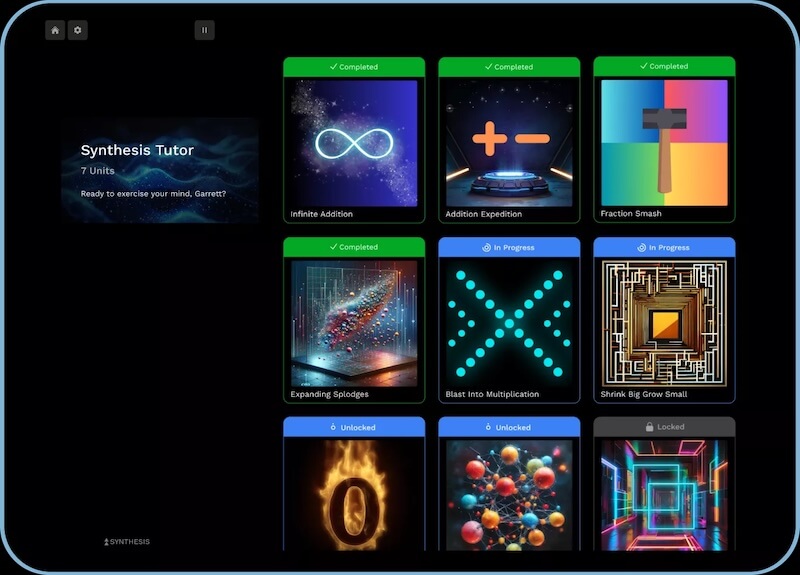
These aren't competitors so much as tools for different kids. Synthesis AI ($29/mo) is for the young child — roughly 5 to 10 — who groans at worksheets and needs math to feel like a game. Khan Academy (free, or $4/mo with its Khanmigo tutor) is for the older, more independent kid, or any family that wants the best value in education, period. Pick by your child, not by the price tag — though the price tag is lopsided.
Here's the honest truth most "best app" lists won't tell you: the wrong pick doesn't just waste money, it wastes momentum. A worksheet-averse 7-year-old put on text-heavy Khan will quietly check out; a typing-fluent 12-year-old put on Synthesis will hit the ceiling in a month. So this comparison is less about which app is "better" and more about which one matches the kid sitting next to you. Both use AI that refuses to just spit out answers. Both are genuinely good. They're just built for different children.
(Both also appear in our full AI math apps roundup alongside six others.)

⚠️ Quick heads-up: Synthesis makes two very different things. This guide compares Synthesis Tutor — the $29/mo solo AI math app. Synthesis also runs Synthesis Teams, a $95/mo live, multiplayer strategy program (no math curriculum). Parents mix these up constantly. We break down Teams at the bottom of this guide — but if it's the math tutor you're comparing to Khan, read on.
The head-to-head

✅ Whichever you pick, remember an app is the daily habit, not the whole diet. Pair either with an in-person Bay Area math program or a free math circle for the depth and peer energy no app delivers. For the full picture, browse our vetted AI tools directory for kids across every subject, or start a hands-on free AI project with your child. And if homework is the real battle, see our guide to the best AI homework
What parents actually say
Synthesis: the "my kid asked to do math" app.
This is the one that turns math-haters around, and the reviews are almost eerily consistent about it — one parent's 10-year-old "went from hating math to asking to do Synthesis Tutor ALL. THE. TIME," another's 6-year-old does an hour a day voluntarily. Parents who'd already cycled through IXL, Prodigy, and ABCmouse single it out as the first one where "they are actually learning the concepts," and it gets specific praise for neurodiverse kids. The ugly part: the question bank is shallow — heavy daily users can drain it in a few months — and more than one parent found the placement too easy, with a child landing "two grades below his level" despite the right grade setting. It builds number sense; it won't rescue a kid who's badly behind, and it won't stretch a math whiz.
Khan: the "costs less than one tutoring hour" app.
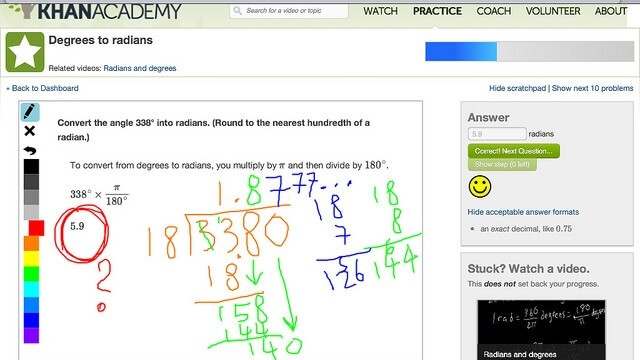
The pitch is unbeatable value — the whole curriculum is free, and Khanmigo runs $4 a month against the $30–100/hour of a human tutor. What parents actually praise, though, isn't the price; it's that the Socratic style makes stuck moments productive. Ask Khanmigo "what's the answer to number 3?" and it answers with a question — "what do you already know about dividing things into equal parts?" The ugly part: that's exactly what frustrates a tired kid at 8pm who just wants the homework done. And Khanmigo only shines if your child already lives in Khan Academy; bolted onto a kid who doesn't, it's less useful.
💡 The "Face Test" — the only test that matters. One mom ran both apps with her two kids for three months and boiled the whole decision down to one thing: watch their face in the first session. Her daughter lit up at Synthesis — colorful, moving, interactive. Her son leaned in to Khanmigo — challenged, thinking, arguing back. Both have free trials. Let the kid's face pick.
So which one?
Go Synthesis if
your child is roughly 5–10, fights worksheets, learns by seeing and hearing, or has already decided they "hate math." Budget for it as a 6–12 month rescue mission, not a forever tool — the point is to rebuild the relationship with math, then graduate.
Go Khan if
your child is 9+, reads and types without friction, needs help across subjects, or you simply want the most educational value a dollar can buy. It's also the only one here that scales — Khan Academy Kids at 4, all the way to AP Calculus.
Or do both, in sequence
— the move a lot of savvy parents land on. Synthesis to light the spark in early elementary, then Khan as the long-haul curriculum once they're 9 or 10. Since Khan's core is free, the overlap costs you nothing extra.
And remember an app is the daily habit, not the whole diet. Pair either with an in-person Bay Area math program or a free math circle for the depth and peer energy no app delivers — or browse our full vetted AI tools directory for everything past math.
Synthesis (Teams) — and who it's actually for
A completely separate product: kids ages 8–14 join live, coach-run sessions (about an hour, twice a week) and play complex multiplayer strategy games — think Proxima or Constellation — where no single kid can win alone. The whole point is soft skills school rarely teaches: negotiation, leadership, speaking up, handling problems with no clean "right" answer. Sessions run in seasons (the next ones start April and September 2026) and cost $95/month.
Parents love it for
what one reviewer called learning "real-life problem-solving skills, how to become a leader, communication, and conflict resolution — the kids aren't told what to do, they have to work it out together." It's a frequent pick for families who want the team-up thrill of Roblox or Minecraft in a heavily moderated, zero-bullying space, and it draws real praise for high-functioning neurodiverse kids who thrive in structured peer logic.
The honest catch:
it's a hard ROI to see if you're practical-minded. The recurring forum complaint is blunt — "in the end, it's basically an expensive video game platform; my kids enjoy Roblox just as much." And critically, it teaches zero school math. If your child is struggling with grade-level arithmetic, Teams won't touch that — that's what Synthesis Tutor (or Khan) is for. The live-session schedule also collides with sports and family routines in a way self-paced apps don't.
Bottom line:
Teams is enrichment for social and strategic thinking, not academics. Many families who can afford both run Tutor (or Khan) for the math and Teams for the soft skills. If you have to choose and your goal is math, it's not the product you want.
FAQ
Is Synthesis AI worth $29 a month?
For the right kid, genuinely yes — parents routinely report math-averse 5-to-10-year-olds asking to practice, which free drill apps rarely pull off. It's a weaker buy for kids far behind (there's no human instruction to catch them up), advanced kids (they'll outpace it), or families who just need broad curriculum coverage, where free Khan does the same job.
Is Khanmigo better than Synthesis for middle schoolers?
Usually, yes. Khanmigo's text-based Socratic tutoring fits students 9+ who read and type comfortably, and it covers the pre-algebra and beyond that middle school demands. Synthesis's visual, voice-first style is built for younger kids and tops out before that.
Are both apps safe for kids?
Both are COPPA-compliant and built to guide rather than hand over answers. Khanmigo has the stronger independent track record — Common Sense Media rated it highly for transparency, safety, and privacy, above general chatbots — and gives parents fuller monitoring. Sit with your child for the first session or two either way, as with any AI.
Can I use both together?
Yes, and it's a common winning pattern: Synthesis for engagement and number sense in early elementary, Khan Academy as the free long-term curriculum from about age 9. Because Khan's core costs nothing, you're only ever paying for the Synthesis overlap.




%20(300%20x%20250%20px)%20(1).avif)
%20(300%20x%20250%20px)%20(2)%202.avif)





-min.avif)