Is Synthesis AI worth it?
These aren't competitors so much as tools for different kids. Synthesis AI (about $29/mo or $119/yr on the family plan) is for the young child — roughly 5 to 10 — who groans at worksheets and needs math to feel like a game. Khan Academy (free, or $4/mo with its Khanmigo tutor) is for the older, more independent kid, or any family that wants the best value in education, period. Pick by your child, not by the price tag — though the price tag is lopsided.
Here's the honest truth most "best app" lists won't tell you: the wrong pick doesn't just waste money, it wastes momentum. A worksheet-averse 7-year-old put on text-heavy Khan will quietly check out; a typing-fluent 12-year-old put on Synthesis will hit the ceiling in a month. So this comparison is less about which app is "better" and more about which one matches the kid sitting next to you. Both use AI that refuses to just spit out answers. Both are genuinely good. They're just built for different children.
(Both also appear in our full AI math apps roundup alongside six others.)

Heads up
Synthesis makes two very different things. This guide compares Synthesis Tutor — the $29/mo solo AI math app. Synthesis also runs Synthesis Teams, a $95/mo live, multiplayer strategy program (no math curriculum). Parents mix these up constantly. We break down Teams at the bottom of this guide — but if it's the math tutor you're comparing to Khan, read on.
Our verdict (Oct 2026)
Under 9 and fighting worksheets? Use Synthesis's 7-day trial and watch whether your child learns or just replays easy games. 9 and up? Start with free Khan Academy and add Khanmigo ($4/mo) only if they get stuck often. 13 and up? ChatGPT's free Study Mode is now a real alternative for homework questions. See our homework helper guide.
The head-to-head
| Khan Academy (+ Khanmigo) | Synthesis Tutor | |
|---|---|---|
| What it is | Free full K–12 curriculum; Khanmigo is the optional AI tutor | Math-only AI tutor |
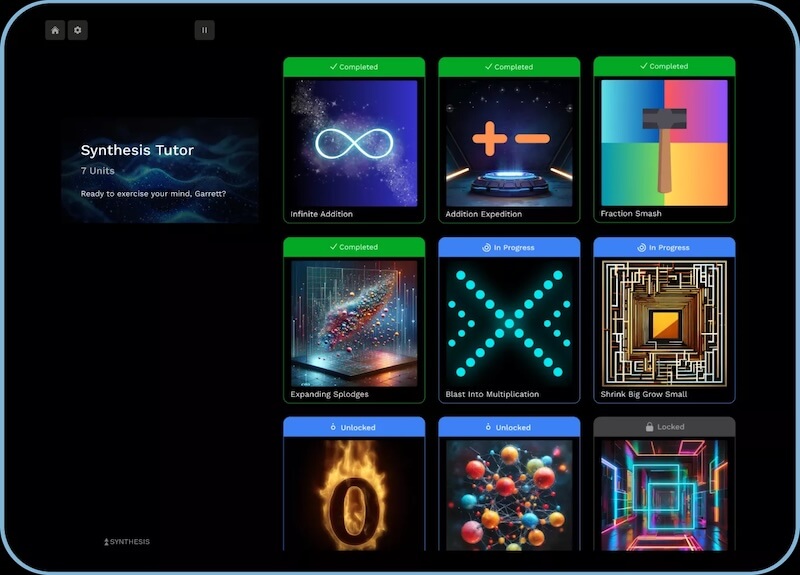
| Teaching style | Socratic text chat that asks questions instead of giving the answer | Visual, voice-guided, game-like problem solving |
| Best ages | 9+ (reading and typing); Khan Academy Kids covers 2–8 free | Strongest around 5–10; covers K–5 math |
| Subjects | Math, science, humanities, test prep | Math only |
| Price (Oct 2026) | Free core; Khanmigo $4/mo or $44/yr for families | Family plan $29/mo or $119/yr, up to 7 kids Individual and lifetime plans too; promos change the numbers, so check at checkout |
| Trial | Core is free; no trial needed | 7-day free trial, no card |
| Parent view | Parent account can see Khanmigo chats | Progress reports; fewer monitoring tools |
| The catch | Can feel dry for game-loving kids; best if they already use Khan | Narrow scope; question bank runs thin for heavy users |

For something hands-on instead, start a free AI project with your child. And if homework is the real battle, see our guide to the best AI homework helpers.
What happened when we subscribed (twice)
We've paid for Synthesis Tutor twice, for the same kid.
The first time, she was 5
The games looked genuinely good. She liked working through simple addition from different angles, much as an abacus or Singapore Math reaches the same answer through different reasoning, which was exactly what we wanted alongside her in-person math class. But we often couldn't log in on the iPad, even after months of deleting and reinstalling the app and sending support our iPad model. Synthesis support refunded the whole year, which we appreciated.
Support also told us they were adding more simple math for 5-year-olds. In hindsight it was too early to subscribe: there weren't many games simple enough for a 5-year-old yet.
The second time, she was 6
The game she'd loved before — the mammal one, which honestly I thought was fun too — was no longer where she could reach it. The progression seemed to have changed.
Like before, she asked to use the app all the time.
By then we used it to keep her entertained rather than to teach her, so we only let her on when we were busy. And we kept finding her "secretly" playing the easy addition and subtraction games she had already mastered, even after she'd learned multiplication.
As a result, we logged in fewer than five times on the annual plan — more than $24 a session.
What we couldn't get past. When she got stuck, it tended to ask the same question again, or she'd guess until something worked. Unless one of us sat beside her, we couldn't tell whether she understood or had just found the right answer. It reminded us of what some Alpha parents described about app-based learning, before Alpha moved to its own Timeback platform.
When we subscribed, the plan didn't include a 7-day trial or cover up to 7 children. Both do now — we don't know when or why that changed.
Why we went back to pen and paper
We didn't scale back because of one app. We did it after reading why Denmark is putting printed books back into classrooms and what MRI studies show about screen time and young brains.
The research on young children points the same way. A 2025 meta-analysis pooling 25 studies of children aged 3 to 7 found hands-on activities worked better than screen-based ones for teaching early coding concepts. The researchers' explanation stuck with us: physical materials let children learn the way they already play, with more attention and better memory.
It isn't settled. A 2026 study of 104 kindergarteners in China found the opposite — the children learning on screens gained more — and its authors credit the difference to how the app gave feedback. We've read the summaries of both, not every page.
That second finding actually explains our experience. If screens work because of their feedback, then an app that repeats the same question when a child is stuck is missing the part that makes a screen worth using.
Parent tip
So for now: an in-person class for the concepts, and pen and paper for the practice.
What parents actually say
Synthesis: the "my kid asked to do math" app.
This is the one that turns math-haters around, and the reviews are almost eerily consistent about it — one parent's 10-year-old "went from hating math to asking to do Synthesis Tutor ALL. THE. TIME," another's 6-year-old does an hour a day voluntarily. Parents who'd already cycled through IXL, Prodigy, and ABCmouse single it out as the first one where "they are actually learning the concepts," and it gets specific praise for neurodiverse kids. The ugly part: the question bank is shallow — heavy daily users can drain it in a few months — and more than one parent found the placement too easy, with a child landing "two grades below his level" despite the right grade setting. It builds number sense; it won't rescue a kid who's badly behind, and it won't stretch a math whiz.
Khan: the "costs less than one tutoring hour" app.
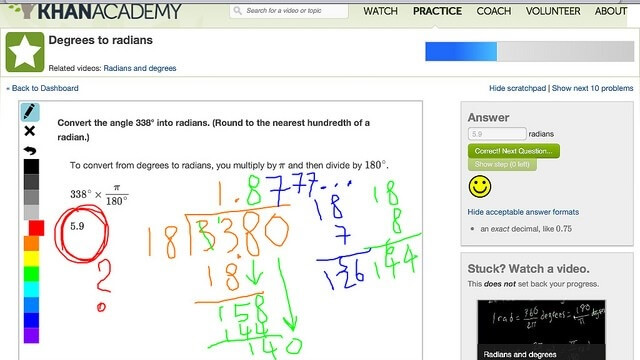
The pitch is unbeatable value — the whole curriculum is free, and Khanmigo runs $4 a month against the $30–100/hour of a human tutor. What parents actually praise, though, isn't the price; it's that the Socratic style makes stuck moments productive. Ask Khanmigo "what's the answer to number 3?" and it answers with a question — "what do you already know about dividing things into equal parts?" The ugly part: that's exactly what frustrates a tired kid at 8pm who just wants the homework done. And Khanmigo only shines if your child already lives in Khan Academy; bolted onto a kid who doesn't, it's less useful.
Parent tip
The "Face Test" — the only test that matters. One mom ran both apps with her two kids for three months and boiled the whole decision down to one thing: watch their face in the first session. Her daughter lit up at Synthesis — colorful, moving, interactive. Her son leaned in to Khanmigo — challenged, thinking, arguing back. Synthesis has a 7-day trial and Khan's core is free, so testing both costs nothing. Let the kid's face pick.
So which one?
Go Synthesis if
your child is roughly 5–10, fights worksheets, learns by seeing and hearing, or has already decided they "hate math." Budget for it as a 6–12 month rescue mission, not a forever tool — the point is to rebuild the relationship with math, then graduate.
Go Khan if
your child is 9+, reads and types without friction, needs help across subjects, or you simply want the most educational value a dollar can buy. It's also the only one here that scales — Khan Academy Kids from age 2, all the way to AP Calculus.
Or do both, in sequence
— the move a lot of savvy parents land on. Synthesis to light the spark in early elementary, then Khan as the long-haul curriculum once they're 9 or 10. Since Khan's core is free, the overlap costs you nothing extra.
And remember an app is the daily habit, not the whole diet. Pair either with an in-person Bay Area math program or a free math circle for the depth and peer energy no app delivers — or browse our full vetted AI tools directory for everything past math.
Synthesis (Teams) — and who it's actually for
A completely separate product: kids ages 8–14 join live, moderated play and discussion sessions and play complex multiplayer strategy games — think Proxima or Constellation — where no single kid can win alone. The whole point is soft skills school rarely teaches: negotiation, leadership, speaking up, handling problems with no clean "right" answer. It costs $95 a month, with 20% off for each added sibling (per Synthesis's help center, Oct 2026). Play sessions run on set weekday-afternoon and Saturday-morning times (Pacific), so check they fit your schedule.
Parents love it for
what one reviewer called learning "real-life problem-solving skills, how to become a leader, communication, and conflict resolution — the kids aren't told what to do, they have to work it out together." It's a frequent pick for families who want the team-up thrill of Roblox or Minecraft in a heavily moderated, zero-bullying space, and it draws real praise for high-functioning neurodiverse kids who thrive in structured peer logic.
The honest catch:
it's a hard ROI to see if you're practical-minded. The recurring forum complaint is blunt — "in the end, it's basically an expensive video game platform; my kids enjoy Roblox just as much." And critically, it teaches zero school math. If your child is struggling with grade-level arithmetic, Teams won't touch that — that's what Synthesis Tutor (or Khan) is for. The live-session schedule also collides with sports and family routines in a way self-paced apps don't.
Bottom line:
Teams is enrichment for social and strategic thinking, not academics. Many families who can afford both run Tutor (or Khan) for the math and Teams for the soft skills. If you have to choose and your goal is math, it's not the product you want.
FAQ
Can I use both together?
Yes. Synthesis for number sense in early elementary, then Khan Academy as the free long-term curriculum from about age 9. Since Khan's core is free, you're only paying for Synthesis — so it's worth confirming your child actually uses it before committing to a year.
Is Synthesis free?
No. In October 2026 the Synthesis family plan was $29 a month or $119 a year for up to 7 children, with a 7-day free trial. There are also single-child and lifetime plans, and promotions change the prices often. Khan Academy's core curriculum is free, and the Khanmigo tutor is $4 a month or $44 a year for families.
What age is Synthesis Tutor for?
It covers the K–5 math curriculum, so roughly ages 5 to 11. It's built for early elementary — younger, visual learners who respond to games. Middle and high schoolers will outgrow it; Khan Academy and Khanmigo are the better fit from about age 9.
Is Synthesis actually an AI tutor?
Synthesis calls it an AI tutor and says plainly it's "not ChatGPT." Its own description of how it works is "adaptive wrong-answer handling." In our use, when our daughter got stuck it tended to repeat the question. We can't tell from outside what's underneath, or whether it has changed since.
How do I use a math app alongside a class or tutor?
Let the class or tutor teach the concept and use the app only for practice — and check which games your child actually picks. Ours kept choosing addition after she'd learned multiplication. We now use an in-person class for concepts and pen and paper for practice.
Is Synthesis better than Khan Academy?
Neither is better overall; they fit different kids. Synthesis Tutor ($29 a month) suits 5- to 10-year-olds who resist worksheets and need math to feel like a game. Khan Academy (free, or $4 a month with Khanmigo) suits more independent kids, about 9 and up, who read and type comfortably.
Is Synthesis Teams the same as Synthesis Tutor?
No. Synthesis Tutor is the solo math app for roughly ages 5 to 11. Synthesis Teams is a separate $95-a-month program where kids 8 to 14 play multiplayer strategy games in live, coached sessions. Teams builds teamwork and negotiation, but it teaches no school math.
Sources
Prices checked October 2026.