Are math circles in the Bay Area free?
Not every strong math kid needs a paid academy. The Bay Area has a deep bench of free and low-cost math circles, library programs, and volunteer tutoring networks — many run by university faculty or trained high-schoolers — where kids learn to think through hard problems instead of drilling worksheets. This directory sorts them by type so you can find what's near you, what it costs, who's teaching, and — from real parent reviews — the honest catch for each. For paid, enrollment-based classes, see our companion guide to Bay Area math programs.
Bay Area Math Circles & Hands-On Networks
The marquee programs — worth traveling for. All open-enrollment.
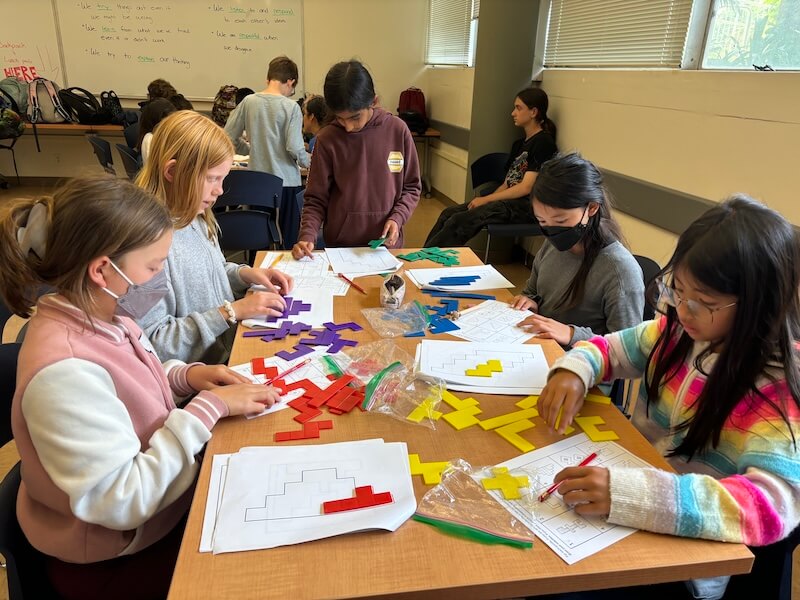
A quick distinction: a math circle isn't tutoring. Tutoring fixes gaps in school math. A math circle throws out the worksheet entirely and explores logic puzzles, proofs, and problem-solving games — closer to a sport or a club than a class.
- Open-enrollment (community circles, OneInMath, PLAY) — any family can join. Your first stop.
- University circles (Berkeley, Stanford, SF) — a fee of roughly $350–$525 a term. Berkeley lists financial aid and SF Math Circle offers reduced tuition by application; Stanford's site doesn't mention aid.
- School-partnered (Children Rising, Mentor Tutor Connection) — free, but delivered inside specific schools by referral. You can't self-enroll, though you can volunteer.
Want to get your teen involved as a volunteer? Scroll down to learn more.
Each university circle bills in its own unit: Berkeley by semester (15 sessions), Stanford by quarter, and SF Math Circle by term. Prices were checked on each program's own site in October 2026.
Heads up
Berkeley Math Circle's own site says BMC-Upper (grades 5–12) will not run in fall 2026 or spring 2027. BMC-Elementary (grades 1–6) has moved to its own website, and the MTRW program for middle schoolers is listed at mathcircle.berkeley.edu.
Looking for structured, results-focused classes instead? Compare the top paid Bay Area math programs by region, or see how RSM, Mathnasium, Kumon and AoPS actually differ. Prefer learning from a screen? See our AI math apps and tools for kids.
Neighborhood Programs
Smaller, hyper-local, volunteer-run — often the easiest to actually get into.
Free & Low-Cost AMC Prep Across the Bay Area
Competition prep for the AMC 8, 10, and 12 isn't only for kids in paid academies — free and student-run options exist across the Bay, though they cluster where student math communities are strongest.
Tri-Valley has the highest density of free, student-led prep: Tri-Valley Tutoring runs a no-cost AMC 8 and MATHCOUNTS curriculum taught by high-schoolers who compete themselves, and PLAY Leadership runs low-pressure AMC 8 foundational sessions.
East Bay & Peninsula families lean on the university circles — Stanford Math Circle and Berkeley's MTRW program build the deep problem-solving skills the AMC rewards, even though they don't drill the test directly.
South Bay competitors often come up through South Bay Math Circle and school math clubs, where older students mentor younger ones toward contests.
For structured, paid AMC coaching (AoPS, AlphaStar) aimed at AIME qualification and elite admissions, see our Bay Area math programs guide.
School-Partnered & Equity-Focused Programs
Free and excellent, but delivered inside specific schools for students who qualify — not open sign-up.
Bay Area tip
Want free ways to keep a child engaged outside school hours? Browse our free weekend kids' events and year-round hands-on STEM activities. And if your child leans toward building over problem-solving, the same free-vs-paid split shows up in our coding & robotics programs guide.
.jpeg)
How Can Teens Volunteer?
Many of these programs don't just accept high-school volunteers — they're run by them. For a teen who loves math, volunteering here builds real leadership experience and President's Volunteer Service Award hours, not just résumé filler. There are two paths, depending on how much responsibility you want.
Teen-led networks put high-schoolers in charge. At these orgs, students are the primary instructors and chapter managers, not back-of-room helpers:
FAQ
Where can my child take the AMC if their school doesn't host it?
Many Bay Area public schools don't administer the AMC — but you have options. Register early: the AMC 10/12 run in November and the AMC 8 in January, with registration opening in the fall. Paid academies like AoPS, RSM, and AlphaStar reserve seats for enrolled students, while AJ Tutoring on the Peninsula offers the AMC 8, 10, and 12 free of charge to all local students (contact them from September 1; current students get priority registration). You can also find authorized test centers through the official MAA "Find a Test Center" tool at maa.org.
What is the difference between a math circle and traditional math tutoring?
Tutoring reinforces standard school grade curriculum, while a math circle focuses on creative logic puzzles, proofs, and collaborative problem-solving games. Traditional tutoring closes skill gaps and helps with school homework. Math circles do not use standard textbooks or speed drills; instead, they build a deep love for non-standard thinking. Kids who find regular school math repetitive often thrive in math circles.
Which free or low-cost math programs serve the Tri-Valley (Dublin, Pleasanton, San Ramon)?
Free math enrichment in the Tri-Valley is primarily led by student-run nonprofits. PLAY Leadership offers peer-to-peer math tutoring and enrichment led by high school mentors across Dublin, San Ramon, and Pleasanton. Tri-Valley Tutoring, also student-run, offers free AMC 8 and MATHCOUNTS prep.
At what age should a child start a math circle?
Children can join math circles as early as Kindergarten or 1st grade. Programs like OneInMath focus specifically on early arithmetic confidence for grades K–3, while university circles run tiered cohorts from elementary through 12th grade. At early ages, classes prioritize curiosity, play, and logic games over speed or competition.
Can high school students volunteer at Bay Area math circles?
Yes. Volunteer networks like OneInMath and PLAY Leadership are explicitly structured to grant teens (ages 13–18) verified volunteer hours, leadership credits, and PVSA tracking by allowing them to teach foundational arithmetic and lead library chapters. University circles like the San Francisco Math Circle also accept high schoolers as classroom assistants.
Are Bay Area math circles free?
Many are. OneInMath, Santa Clara Math Circle, South Bay Math Circle and PLAY Leadership charge no tuition. University circles charge per term: Berkeley Math Circle Elementary is $350 a semester and Stanford $500–$525 a quarter. Berkeley lists financial aid, and SF Math Circle offers reduced tuition by application.
How much does Berkeley Math Circle cost?
BMC-Elementary (grades 1–6) costs $350 a semester for fall 2026 and spring 2027, plus a $10 PayPal fee and a $35 application fee for new students, and financial aid is available. BMC-Upper is paused for 2026–27. Berkeley's separate MTRW evening program for middle schoolers costs $910 for fall 2026.
How much does Stanford Math Circle cost?
Stanford Math Circle costs $500 a quarter online and $525 in person, or $1,485 and $1,545 for all three quarters of 2026–27. In-person classes are for grades 9–12 only; younger students join online. Its site doesn't mention financial aid, and fall registration closed October 2.
Do math circles help with AMC 8 prep?
Yes, indirectly. Math circles build the deep problem-solving skills the AMC rewards, even though they don't drill the test itself. For direct prep, Tri-Valley Tutoring runs free AMC 8 sessions, and PLAY Leadership offers low-pressure AMC 8 foundations; paid options like AoPS cover structured coaching.


%20(300%20x%20250%20px)%20(1).avif)