Excessive screen time is simply not good for our kids. We’ve watched the global headlines as hyper-connected, high-performing STEM countries like Singapore and South Korea have systematically pushed screens out of the classroom to protect academic focus. If you've been tracking these shifts, our AIFunLab Learning Resource Hub explores exactly how these structural policies alter a child's day. Governments are moving fast because the underlying neuroscience—which we broke down in our report on how heavy screen hours accelerate premature cortex thinning in brain MRIs—presents a harsh reality check. This isn't just happening across Asia either; it's part of a broader Western wave we analyzed in our deep dive into Denmark's aggressive classroom phone rollbacks.
Now, that global momentum has landed right on our doorsteps. California's Phone-Free School Act (AB 3216) requires every public school district in the state to adopt a smartphone restriction policy by July 1, 2026. Every district. Every school. No exceptions — or so it sounds.
Here's the catch: the law doesn't require the same policy everywhere. It requires a policy. And in a state with over 1,000 school districts, that means what happens to your child's phone this fall depends almost entirely on your zip code.

Two Laws, Not One
Most parents have heard of AB 3216. Fewer know there's a second bill moving through Sacramento right now.
AB 1644 — a stricter follow-up bill — would require all TK–12 schools to implement a full bell-to-bell smartphone ban by July 2027. When it first came to the Assembly Education Committee, it covered kindergarten through 12th grade. Under pressure from school administrators and committee chair Assemblymember Darshana Patel — a former school board president — high schools were removed from the bill. The scaled-back version advanced, but the fight isn't over.
"I feel passionately that the evidence is overwhelming, that bell-to-bell smartphone bans across the country have proven to be effective," said Assemblymember Al Muratsuchi, one of the bill's authors, after the hearing. (Politico, April 2026)
Meanwhile, a Public Policy Institute of California poll released in April found something that should make parents pause: 52% of California parents with school-age children support policies that allow phone use between classes and at lunch. Only 40% want an all-day ban.
So while Sacramento is debating how strict to go, parents themselves are split.
What Bay Area Districts Are Actually Doing
This is the table most parents actually need. "Phone ban" means something different in every neighborhood.
If your child is in SFUSD: The practical change this fall is almost nothing. SFUSD is the only major Bay Area district actively choosing minimum compliance for now — the "off and away during class" rule already existed. The real policy decision for SF families happens over the next 18 months.
If your child is in Sequoia Union: Phones are restricted in class but still accessible at lunch and breaks — for now. The district has built in a December 2026 vote to potentially go bell-to-bell. Worth paying attention to.
Does It Actually Work? The Honest Answer
Parents deserve a straight answer here, not cheerleading.
The largest U.S. study of school phone bans ever conducted — National Bureau of Economic Research, May 2026, covering more than 40,000 schools — found:
- Phone use during school drops dramatically ✓
- Teacher-reported classroom management improves ✓
- Student and teacher wellbeing shows small but real improvement ✓
- Test scores: little to no immediate change ✗
- Attendance: little change ✗
- Online bullying that happens at home: not affected ✗
So a phone ban is not an academic intervention. It's an attention and wellbeing intervention.
But here's what Bay Area data actually shows:
At Northgate High School in Walnut Creek — part of Mt. Diablo Unified — reports of harassment fell 33% and bullying dropped 50% since the district banned phones.
Teachers reported students are more focused, have livelier discussions, and don't get "riled up" about social media posts during the day.(CalMatters / Mt. Diablo Unified board presentation, 2026)
The only complaints? Students couldn't use their cameras to photograph assignments, and locking up phones cut into a bit of class time. And yes — some students found workarounds.
That last part matters. A ban written on paper is not the same as a ban that works in practice. Enforcement culture, teacher buy-in, and what replaces the phone all determine whether any of this actually helps your child.
Why California Is Moving Slowly — The Real Reason
You might wonder why California — home to some of the most tech-forward thinkers in the world — is also one of the slower states to act on this.
Would it be tech company lobbying? or if it is local control politics.
The California School Boards Association has been consistent: "In as diverse a state as California is, a one-size-fits-all, blanket policy is not the right solution." School administrators argue that stricter rules imposed from Sacramento undermine their ability to make decisions for their specific communities.
That tension is real. A rural district and a Silicon Valley district have genuinely different needs. But it also means that the parents most motivated to push for change have to do it school board by school board.
Parent coalitions like Distraction-Free Schools, MAMA (Mothers Against Media Addiction), and Schools Beyond Screens are doing exactly that — holding biweekly calls, coordinating talking points for board meetings, and pushing district by district. One parent-therapist leading the effort put it plainly:
"It is incredibly difficult for families to navigate. You've got your 11-year-old flipping back and forth between YouTube or Roblox or whatever, on the same screen in which they're supposed to be doing their homework."— Julie Frumin, co-lead, Distraction-Free Schools, Politico April 2026
That sentence captures the problem better than any policy document. The phone ban addresses the phone. It doesn't address the Chromebook, the tablet, or the laptop your child also has open.
What the Ban Doesn't Cover — And What Parents Miss
This is the part most coverage skips.
AB 3216 applies to personal smartphones. It does not apply to:
- School-issued Chromebooks
- Classroom tablets
- Educational AI tools
- Laptop-based assignments
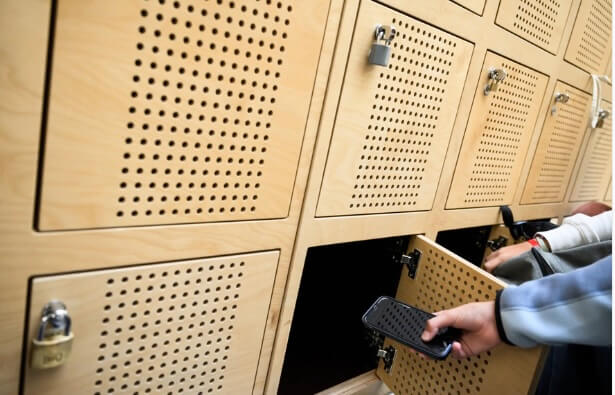
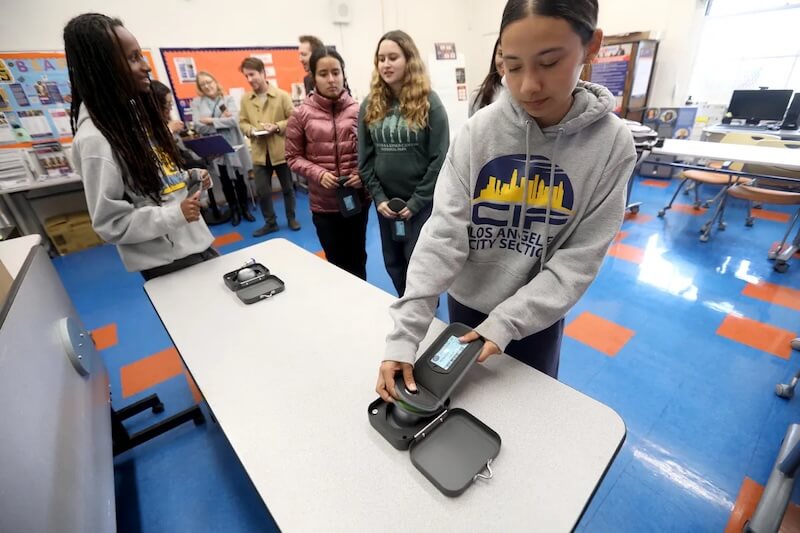
So a child whose school implements a strict Yondr pouch system could still spend three hours in front of a school laptop, switching between Google Docs and YouTube, with no policy restriction at all.
The ban creates a real opportunity. It doesn't automatically fill it.
What fills the reclaimed time — at school and at home — is the decision that actually determines whether any of this helps. For a deeper look at what brain research says about why that distinction matters, read our MRI breakdown on screen time and child brain development.
Three Questions to Ask Your School Before September
Before the first day of school, it's worth knowing:
1. Is it bell-to-bell or class-only?The difference matters significantly. A classroom-only policy means your child still has phone access at lunch and between classes — which is when much of the social comparison and distraction happens.
2. Are smartwatches included?Some policies cover smartwatches, some don't. A student with a smartwatch can still receive notifications, messages, and social media alerts even with their phone in a pouch.
3. What happens at lunch and recess?This is where many policies are weakest. Northgate's improvement in bullying and harassment came from a full-day ban — not a class-only restriction.
What Should Replace the Phone?
Not all screen time is equal. There's a meaningful difference between passive consumption — scrolling, short-form video, group chat — and active creation — building, coding, designing, problem-solving. The brain research on this distinction consistently shows different outcomes for attention, focus, and development.
For Bay Area families, the options are genuinely good:
- After school: Coding and robotics programs — by age and city, from beginner to competitive
- At home: Free hands-on AI activities — building and creating, not consuming
- This weekend: Bay Area STEM events for kids — what's happening near you
- Screen-free outings: Free Bay Area museum days
- Summer: 2026 STEM camps — check availability now
- School choices: If you're evaluating schools based on how seriously they take this, Bay Area private schools and AIFunLab's full resource guide are good starting points
"Tech companies are making all this money off students' phone addiction. It's not a fair fight because students are a vulnerable population. School should be a place for learning."
— Rishaan Marwaha, high school freshman, who testified before the California Assembly Education Committee in support of stricter phone bans, May 2026
Marwaha also admitted he was a phone addict himself — spending hours on Instagram reels "when I could have been doing things I actually like, like playing basketball or going to the gym." That honesty from a teenager lands harder than any researcher quote. The ban creates the space. What fills it is the decision that matters.
And one thing you can do today, no school policy required: set a device sleep timer at home. On iOS, Screen Time takes two minutes to set up. On Android, Family Link does the same. Protecting sleep is the highest-impact home change most families aren't making — and the brain research on sleep and cortical development explains exactly why.
Frequently Asked Questions
Does the school phone ban apply to smartwatches?
Yes. California's Phone-Free Schools Act covers both smartphones and smartwatches, restricting any cellular-enabled personal device during the school day. Because enforcement varies, check whether your district's specific policy explicitly names smartwatches. View the full Bay Area restricted school devices list above
Are phones allowed during lunch and passing periods?
It depends entirely on your district and grade level. While most middle schools use strict "bell-to-bell" bans, high school policies vary across the Bay Area:
- San Mateo Union High: Uses Yondr pouches all day, including lunch.
- Sequoia Union High: Restricts phones during class only (a December 2026 vote may change this to bell-to-bell).
What are the consequences if my child gets caught with their phone?
Schools handle discipline locally, but standard penalties usually follow a tiered system:
- First offense: The teacher confiscates the device for the rest of the class period.
- Repeat offenses: A parent or guardian must physically collect the device from the front office.
- Property damage: Districts using Yondr pouches often treat tampering with or cutting the pouch as a separate disciplinary infraction.
Will students use Yondr pouches, lockers, or backpacks?
The state mandate leaves enforcement entirely up to local school boards, meaning there is no single statewide method. Local examples include:
- Yondr Pouches (Locked bags): Used by San Mateo Union High and Tamalpais Unified.
- Phone Pockets (Classroom cubbies): Used by Palo Alto Unified.
- Backpack Rule (Off and away): Currently used by SFUSD.
Curious what countries that implemented this years ago actually learned? That's Post 2. Coming soon.
For the brain science behind why what replaces the phone matters: What MRI Studies Show About Screen Time and Child Brain Development →
For what Denmark's approach taught us — and what Bay Area parents can borrow from it: What Denmark Knows About Your Child's Brain →

Derivatives & startup experience across 3 continents, including China. Elementary school mom to one very active kid. LSE MSc.




%20(300%20x%20250%20px)%20(1).avif)
%20(300%20x%20250%20px)%20(2)%202.avif)






-min.avif)