


At a glance
By region — San Francisco (Sterne) · Marin / North Bay (North Bridge) · Peninsula (Charles Armstrong, Sand Hill, Athena) · South Bay / Silicon Valley (TLC at Almaden) · East Bay (Stellar, Hope, Bayhill) · Tri-Valley (no specialist — nearest options)
Need it to continue through high school? → Sterne (SF, K–12) or Bayhill (Berkeley, 9–12). Everything else ends at 8th grade.
Watching the budget? → Stellar in Newark (~$26–30K, roughly half the Peninsula flagships), plus the free & lower-cost paths at the bottom.
Gifted and dyslexic (2e)? → start here
Public options → here
Need it to continue through high school? → Sterne (SF, K–12) or Bayhill (Berkeley, 9–12). Everything else ends at 8th grade.
Watching the budget? → Stellar in Newark (~$26–30K, roughly half the Peninsula flagships), plus the free & lower-cost paths at the bottom.
Gifted and dyslexic (2e)? → start here
Public options → here
San Francisco
A note on Star Academy (San Rafael): a genuine, well-regarded special-education school — but its mission spans a broad range of differences (dyslexia, ADHD, autism, processing delays), and we couldn't verify a named OG/Slingerland/Wilson program at its core. A real option for a broader profile — and it holds NPS status (see the public-funding path below) — but not a dyslexia specialist by this page's bar.
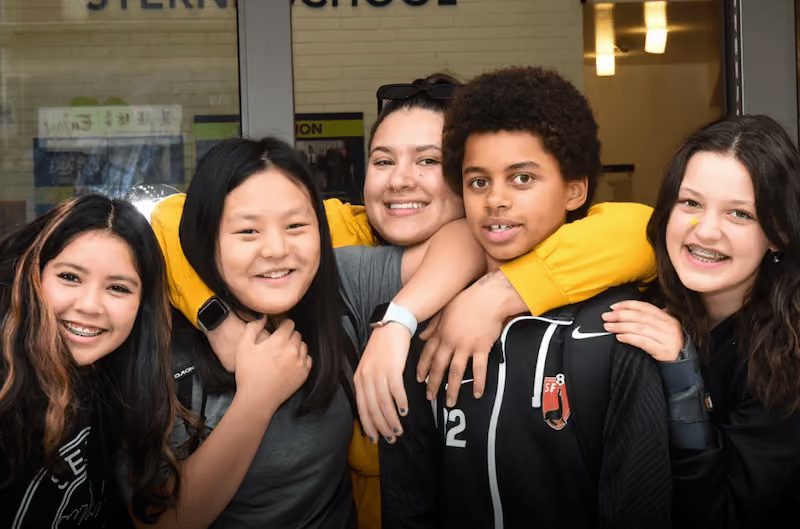
By high school, fit is as much about belonging as academics — and Sterne is one of the few Bay Area specialist schools that carries kids all the way through 12th grade.
TWO MINUTES
What's actually right for your kid?
Answer a few questions and we'll sned you what you're actually looking for.
Peninsula
The Bay Area's deepest cluster of decent dyslexia specialists.
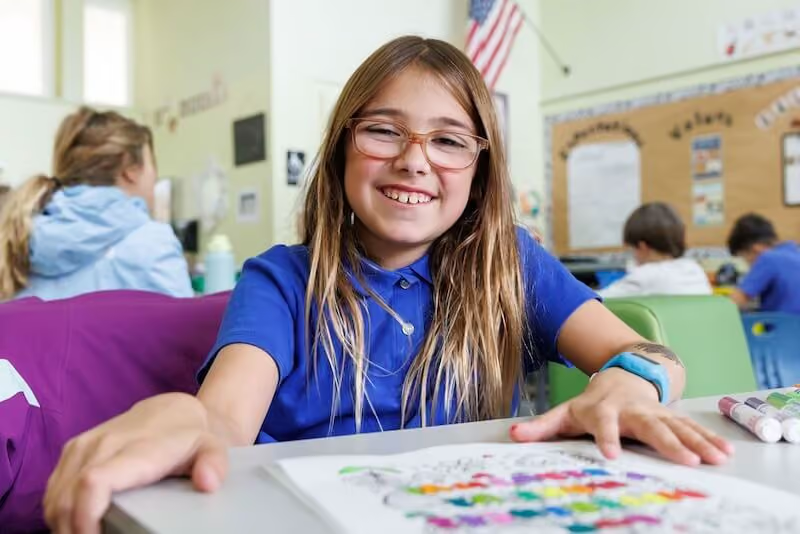
Fifty-plus years in, Armstrong's whole day is built around structured literacy — which is why a struggling reader can still walk in smiling like this.
South Bay
Elsewhere in Silicon Valley: families closer to Palo Alto look to Athena or Sand Hill (under Peninsula), or commute to Belmont for Charles Armstrong. For 2e kids, the gifted specialists Helios (Sunnyvale) and Tessellations (Cupertino) are often the better South Bay fit than a pure remediation school — full detail on our gifted & advanced page.
.webp)
At Almaden's OG-accredited program, kids get intensive reading work and the electives and field trips of a normal school — remediation without giving up childhood.
East Bay
A caution on Raskob (Oakland): long a go-to LD school, but recent parent reports describe financial strain tied to its former university parent, staff losses, and a year without an Orton-Gillingham specialist on staff. We're leaving it off until the program is clearly rebuilt — exactly the kind of thing a directory won't tell you.
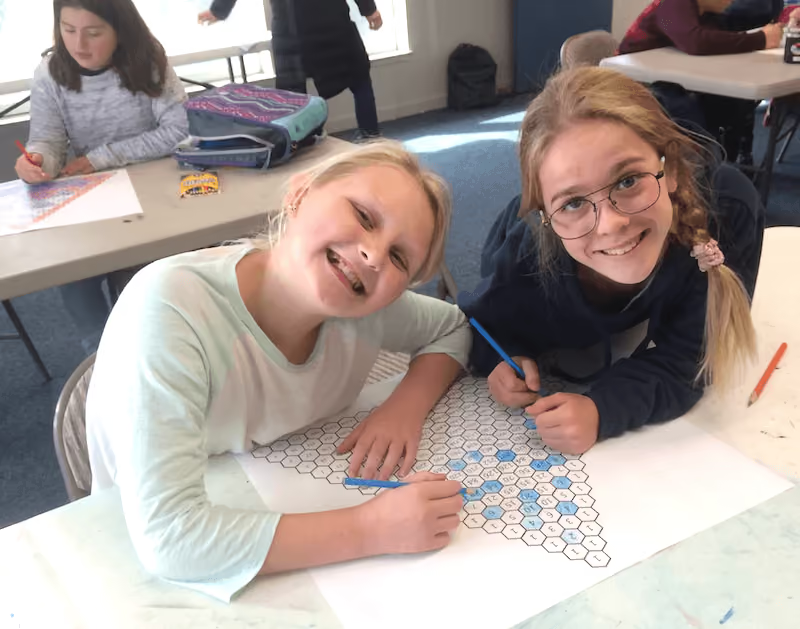
Hope's small Slingerland classrooms mean close-in instruction where no one's singled out — often the fastest way a dyslexic kid rebuilds momentum.
Tri-Valley
The nearest real options: Hope Academy in Concord (the shortest drive for most Tri-Valley families), Stellar in Newark, Bayhill in Berkeley for high school, or a mainstream school plus a privately hired OG/Slingerland educational therapist (below). We'll add Tri-Valley schools if genuine specialists open — but we won't pad the list.
TWO MINUTES
What's actually right for your kid?
Answer a few questions and we'll sned you what you're actually looking for.
Twice-exceptional (2e): gifted and dyslexic
This is the overlap that catches Bay Area tech families off guard — a child years ahead in math or logic who struggles with reading, writing, or processing speed. A pure remediation school can under-challenge them; a pure gifted school can leave the dyslexia unsupported. The realistic middle ground:
Athena Academy (Palo Alto) — the only Bay Area school explicitly built for dyslexic + 2e learners, grades 1–8 (listed above).
Sterne (SF) and Sand Hill (Palo Alto) — both accommodate 2e profiles by letting kids track ahead in math/science while getting explicit structured-literacy instruction in language arts.
Helios School (Sunnyvale) and Tessellations (Cupertino) — gifted specialists that genuinely support 2e kids, but they are accommodating, not remediating: neither runs full-day OG instruction. Full detail on our gifted & advanced schools guide.
For a 2e child, the reading difficulty is almost always the harder-to-serve need, so start here — but if the giftedness is the more pressing gap, our gifted & advanced schools guide is the better starting point.
Athena Academy (Palo Alto) — the only Bay Area school explicitly built for dyslexic + 2e learners, grades 1–8 (listed above).
Sterne (SF) and Sand Hill (Palo Alto) — both accommodate 2e profiles by letting kids track ahead in math/science while getting explicit structured-literacy instruction in language arts.
Helios School (Sunnyvale) and Tessellations (Cupertino) — gifted specialists that genuinely support 2e kids, but they are accommodating, not remediating: neither runs full-day OG instruction. Full detail on our gifted & advanced schools guide.
For a 2e child, the reading difficulty is almost always the harder-to-serve need, so start here — but if the giftedness is the more pressing gap, our gifted & advanced schools guide is the better starting point.
How we evaluated these schools — and what to ask
What we verified: that each school's core mission is genuinely language-based learning differences (not a mainstream school with a resource room), that it names a real structured-literacy method in its own materials, that its ratios are actually small, and that independent sources — Berkeley Parents Network, school-review sites, specialist directories — describe it the same way it describes itself. Every school here cleared that bar; where one didn't, we said so above and why.
What we couldn't verify — and neither can any list: whether every teacher your child would actually have holds a current, individual certification. Staff turn over yearly. Tuition moves yearly too — where we show a range or say "confirm," the school hadn't published an exact figure we'd stand behind, and we'd rather say so than print a stale number.
Which is why the single most useful thing on this page may be one question, on every tour
"Which structured-literacy method do you use day-to-day, and are the teachers who deliver it individually trained or certified in it — or following a curriculum supervised by a specialist?"
A real specialist answers in one breath. A school that "supports all learners" talks about differentiation.One practical note: these schools run $26,000–$60,000+, and admission almost always starts with a formal evaluation — which is also what unlocks the free public paths covered next.
What we couldn't verify — and neither can any list: whether every teacher your child would actually have holds a current, individual certification. Staff turn over yearly. Tuition moves yearly too — where we show a range or say "confirm," the school hadn't published an exact figure we'd stand behind, and we'd rather say so than print a stale number.
Which is why the single most useful thing on this page may be one question, on every tour
"Which structured-literacy method do you use day-to-day, and are the teachers who deliver it individually trained or certified in it — or following a curriculum supervised by a specialist?"
A real specialist answers in one breath. A school that "supports all learners" talks about differentiation.One practical note: these schools run $26,000–$60,000+, and admission almost always starts with a formal evaluation — which is also what unlocks the free public paths covered next.
Public & charter immersion
Here's the part the private schools won't bring up: some of the best immersion in the Bay Area is free. The catch isn't quality — it's that you get in by lottery or address, not by admission, and quality can swing year to year by campus.
Not every path is a full school — clinics like Lindamood-Bell offer intensive one-on-one blocks, a lower-commitment option many families use alongside a mainstream school.
What Bay Area Parents Ask
What's the difference between a school that "supports learning differences" and a real dyslexia school?
A mainstream school with a learning-support program can accommodate mild needs — extra time, a resource teacher, a 504 plan. A dedicated dyslexia school is built entirely around structured literacy: trained Orton-Gillingham or Slingerland instruction, small groups, and staff who specialize in it. For significant dyslexia, the specialist environment is usually what actually moves the needle; accommodation alone often isn't enough.
Which Bay Area schools specialize specifically in dyslexia?
The dedicated dyslexia and language-based learning-difference schools are Charles Armstrong (Belmont), Athena Academy and Sand Hill (Palo Alto), North Bridge Academy (Mill Valley), Stellar Academy (Newark), Hope Academy (Concord), the OG-accredited Learning Center at Almaden Country Day (San Jose), and Sterne School (San Francisco — one of the few through 12th grade). Charles Armstrong is generally considered the West Coast flagship.
Do these schools use Orton-Gillingham?
Yes — every school listed uses Orton-Gillingham, Slingerland (a classroom adaptation of OG), Wilson, or a closely related structured-literacy method, and names it publicly. When you tour, ask which method your child would get and whether the instructors are individually trained or certified in it — that's the part no website (including this one) can verify for you.
My child is gifted AND dyslexic. Where should we look?
That's twice-exceptional (2e). Athena Academy (Palo Alto) is explicitly built for it; Sterne and Sand Hill accommodate 2e tracking; the gifted specialists Helios (Sunnyvale) and Tessellations (Cupertino) support 2e kids but don't remediate. Read this guide alongside our gifted & advanced guide, and prioritize the harder-to-serve need.
We're a bilingual family — should a dyslexic child be in a language-immersion school?
Dyslexic kids can absolutely become bilingual, but immersion programs front-load exactly the skill — decoding written language — that dyslexia makes hardest, and immersion schools rarely offer structured-literacy remediation. Most specialists suggest securing reading remediation first, keeping the second language alive orally at home, and revisiting formal immersion once reading is solid. If you're weighing both paths, our bilingual & immersion schools guide covers the immersion side — and the tour question above works on those schools too.
Do I need a formal diagnosis to apply?
Usually, yes. Most specialist schools want a neuropsychological or educational evaluation — several (Armstrong, North Bridge) also require testing showing average-or-above cognitive ability. If you're early in the process, the evaluation is step one, and it also unlocks free public-school services.
Any affordable options?
Look into Stellar Academy (Newark) as the tuition is lower than ones in Peninsula. Sterne gives aid to ~30% of families (average award ~$22,000), and Armstrong's assistance program offsets meaningful costs. And two schools — Star Academy and Bayhill — hold NPS status, meaning a district can be compelled to fund placement through the IEP process.
%20(300%20x%20250%20px)%20(1).avif)


