


At a glance
Gifted-specialist — Nueva, Helios, Tessellations, Proof
Accelerated prep — Harker, Menlo, Crystal Springs, College Prep, Castilleja
Self-paced / mastery — Khan Lab, Bowman
Free public alternatives — Lowell, Monta Vista, Gunn, Saratoga & more
Weighing tuition against local public options? Jump to public schools alternatives for the gifted and advanced.
Accelerated prep — Harker, Menlo, Crystal Springs, College Prep, Castilleja
Self-paced / mastery — Khan Lab, Bowman
Free public alternatives — Lowell, Monta Vista, Gunn, Saratoga & more
Weighing tuition against local public options? Jump to public schools alternatives for the gifted and advanced.
San Francisco
Thin on gifted-specialist options — but home to the region's math school and its most distinctive "learn by making" school.
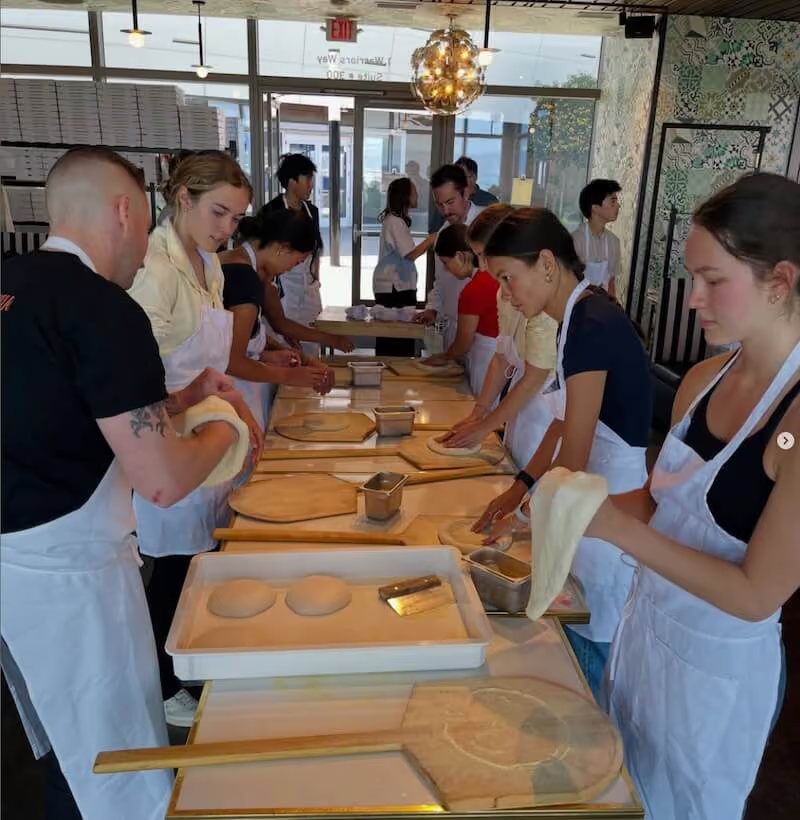
SF University High extends learning beyond the desk. Hands-on workshops—like culinary chemistry—build practical life skills, teamwork and more.
Peninsula
Where the region's gold-standard gifted school sits, alongside its most established college-prep names.

Menlo's a step less cutthroat than Harker, and more mixed.
South Bay
The gifted-specialist and STEM-powerhouse cluster — and the one most Silicon Valley tech families search for.

Menlo's a step less cutthroat than Harker, and more mixed. But if your kid's coming from public school, the pace is a real adjustment — and getting into the top tracks is tough if they haven't already done the prerequisites.
30-second quiz
Is a gifted program right for your kid?
Tell us your kid's age and interests. We'll send what fits.

East Bay
It has one of the strongest college-prep schools in the region.
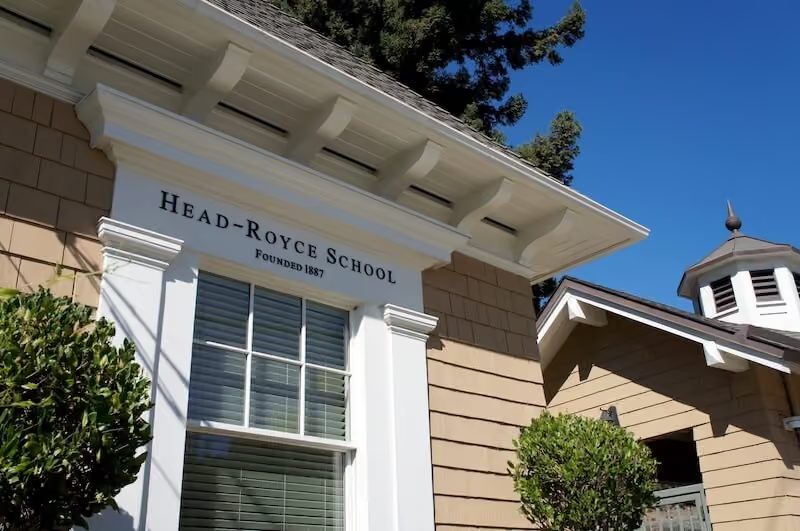
Head-Royce balances high academic standards with holistic personal growth.
Tri-Valley
The thinnest region for advanced options — largely two strong independents plus chains.

Quarry Lane is a strong option in the Tri-Valley for families seeking structured academic acceleration, high math pacing, and the IB Diploma without driving across the bridge.
Is private worth it? Top public alternatives by region
The thinnest region for advanced options — largely two strong independents plus chains.
Gifted v.s. Advanced
1. Gifted-Specialist Schools (e.g., Nueva, Helios, Tessellations, Proof)Built explicitly for cognitive giftedness and asynchronous development (e.g., a child doing high-school math who still needs early-elementary social support). These schools group by ability rather than age, integrate heavy social-emotional learning (SEL), and often require IQ/cognitive testing or math assessments to enter.
2. Accelerated College Preps (e.g., Harker, Menlo, Crystal Springs, College Prep, Castilleja)Built for traditional high achievers. These schools offer fast-paced, high-volume academics, deep STEM/humanities tracks, and elite university placement. They serve self-disciplined, highly regulated students—not "gifted specialists"—and a gifted child who needs executive function support can flounder under the sheer volume.
3. Self-Paced & Adaptive Models (e.g., Khan Lab, Alpha)Built around mastery and technology integration. These schools let self-motivated kids move at their own velocity using adaptive tools and project blocks. They are ideal for bright children who are bored by traditional grade pacing, but require strong internal drive and independent focus.
2. Accelerated College Preps (e.g., Harker, Menlo, Crystal Springs, College Prep, Castilleja)Built for traditional high achievers. These schools offer fast-paced, high-volume academics, deep STEM/humanities tracks, and elite university placement. They serve self-disciplined, highly regulated students—not "gifted specialists"—and a gifted child who needs executive function support can flounder under the sheer volume.
3. Self-Paced & Adaptive Models (e.g., Khan Lab, Alpha)Built around mastery and technology integration. These schools let self-motivated kids move at their own velocity using adaptive tools and project blocks. They are ideal for bright children who are bored by traditional grade pacing, but require strong internal drive and independent focus.
30-second quiz
What's actually right for your kid?
Tell us your kid's age and interests. We'll send what fits.
What Bay Area Parents Ask
Which Bay Area schools are best for a bright child who gets bored and needs to move faster?
Look for self-paced or flexible mastery models:
Khan Lab School (Mountain View): Allows students to advance based on content mastery rather than age/grade level.
Alpha School (SF): Features adaptive, self-paced learning technology.
Tessellations (Cupertino): Groups math by ability level rather than grade, using problem-solving curricula like Art of Problem Solving.
Note: Self-paced environments suit independent, intrinsically motivated kids; a child who needs external structure to stay on track usually fares better in a traditional prep school.
Khan Lab School (Mountain View): Allows students to advance based on content mastery rather than age/grade level.
Alpha School (SF): Features adaptive, self-paced learning technology.
Tessellations (Cupertino): Groups math by ability level rather than grade, using problem-solving curricula like Art of Problem Solving.
Note: Self-paced environments suit independent, intrinsically motivated kids; a child who needs external structure to stay on track usually fares better in a traditional prep school.
Which schools require IQ or admissions testing?
The Nueva School requires formal cognitive/IQ testing as a core part of its application process because it is explicitly designed as a gifted specialist school. Proof School requires an advanced math assessment, as its daily schedule revolves around deep mathematical reasoning. Most traditional prep schools (Harker, Menlo, Crystal Springs) rely on standard entrance exams (ISEE/SSAT) and school transcripts rather than formal giftedness evaluations.
What's the difference between a gifted-specialist school and a rigorous prep school?
Gifted-specialist schools (Nueva, Helios, Tessellations, Proof) build their entire model around how gifted minds actually develop—grouping by ability instead of age, supporting asynchronous growth, and prioritizing social-emotional health. Rigorous prep schools (Harker, Menlo, College Prep) serve traditional high achievers with fast-paced, high-volume academics geared toward elite college admissions, assuming a self-disciplined, well-regulated student.The rule of thumb: Choose a specialist school for a child whose cognitive needs are unusual, and a prep school for a child whose academic drive and output are unusual.
What's the real downside of Harker versus Nueva?
They fail different kids in different ways:
Harker's risk is pressure: Its fast-paced, competitive, high-output culture can overwhelm a child who isn't internally motivated to compete.
Nueva's risk is fit and access: It is notoriously difficult to get into outside of main entry grades, and its hyper-wealthy demographic can occasionally feel isolating for middle-class tech families.
Harker rewards disciplined, high-performing achievers; Nueva rewards asynchronous, self-directed gifted thinkers. Neither is "better"—they serve fundamentally different minds.
Harker's risk is pressure: Its fast-paced, competitive, high-output culture can overwhelm a child who isn't internally motivated to compete.
Nueva's risk is fit and access: It is notoriously difficult to get into outside of main entry grades, and its hyper-wealthy demographic can occasionally feel isolating for middle-class tech families.
Harker rewards disciplined, high-performing achievers; Nueva rewards asynchronous, self-directed gifted thinkers. Neither is "better"—they serve fundamentally different minds.
Which schools suit children of tech families or lean heavily into technology?
Khan Lab School and The Harker School are top choices among Silicon Valley engineering families—Khan Lab for its adaptive, tool-driven framework and Harker for its deep STEM labs and math competitions. In Cupertino, Tessellations attracts tech families for its inquiry-driven problem-solving culture. In San Francisco, Lick-Wilmerding blends computer science with physical engineering, requiring students to build with their hands in fabrication shops, not just sit behind screens.
Don't see your school?
Run a Bay Area private school? Get a page with your prices checked and dated.
Work with us →
%20(300%20x%20250%20px)%20(1).avif)


