For most families the best starting points are Khan Academy Kids (free, ages 4–7), Komodo Math (structured daily practice, ages 5–11), and Beast Academy (advanced, logic-heavy). For homework help, Photomath gives the clearest step-by-step solutions; for a Socratic AI tutor, try Khanmigo. Apps build the daily foundation — pair them with an in-person math program or a free math circle for real depth.
✅ Prefer in-person? Compare Bay Area after-school math programs (RSM, AoPS, Kumon) or find free math circles and volunteer tutoring. Leaning toward building over problem-solving? See our coding & robotics guide.
Best AI math apps for kids at a glance (2026)
Khan Academy Kids Ages 4–7 Free
Best free app for early learners. Learner-paced early math — no ads, no in-app purchases; covers math, logic, literacy, and SEL. Rating: 4.9+.
✓ 100% free; used by educators and therapists · ✗ Not advanced enough for middle-graders. Often underrated because it's free — it builds the number sense and logic behind lifelong problem-solving.
Komodo Math Ages 5–11 ~$10/mo
Best adaptive app for daily structure. Teacher-designed adaptive paths — 10–15 minutes a day builds mastery. Rating: 4.7.
✓ Clean, distraction-free; strong homeschool reviews · ✗ Minimal gamification for kids who need stimulation. "Like a real tutor, not a game with coins" — closer to tutoring than a game.

Elephant Learning Ages 7–14 ~$35/mo
Best for catching up (or getting ahead) fast. Real-time diagnostics + concept-based acceleration — claims a year of math in three months. Rating: 4.6.
✓ Weekly parent reports; concept-first design · ✗ Premium price; plain interface. Adapts to how a student got the answer, not just whether it's right.
Khanmigo Grades 5–8 $4/mo
Best Socratic AI tutor for middle school. Guides students to think instead of handing over answers; one account covers up to 10 kids, free for teachers.
✓ Built by Khan Academy on GPT-4; explains with analogies · ✗ Socratic pace frustrates answer-seekers; needs a parent subscription. For daily assignment help, see our free AI homework helper guide.
🧭 Deciding between these two?
They serve completely different learners. Choose Synthesis Tutor for an early-elementary child (ages ~5–10) who learns through visuals, puzzles, and voice. Choose Khan Academy (+ Khanmigo) for a 9+ kid who types comfortably and wants a Socratic tutor across all subjects — at $4/mo vs $29/mo. Full pricing, parent reviews, and verdict: Khan Academy vs. Synthesis AI comparison guide →.
Brighterly Ages 6–13 ~$30/session
Best mix of AI and a live teacher. AI tracking paired with 1-on-1 human teaching. Rating: 4.7 across parent forums.
✓ Real teachers, strong visuals and manipulatives · ✗ Must schedule ahead; pricier than app-only. Many parents say it's the first time their kids enjoyed math tutoring.

Photomath Ages 11+ Free + premium
Best AI homework helper. Snap a photo, get step-by-step solutions — not just answers. Rating: 4.8.
✓ Great for process and for parents decoding "the new math" · ✗ Can tempt shortcuts; best features paywalled. Not a curriculum — the best homework helper we've tested.
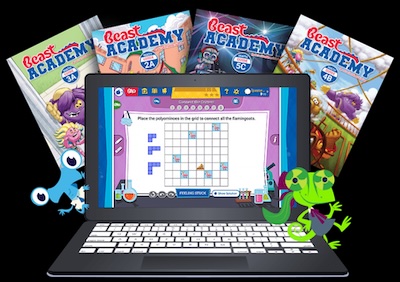
Beast Academy Ages 8–13 Subscription
Best story-based logic app for advanced elementary kids. Comic-book instruction focused on logic and spatial thinking. Rating: 4.8+.
✓ Teaches kids to think, not memorize · ✗ Tough below grade level. The elementary arm of Art of Problem Solving — the on-ramp to the competition math track.
Synthesis Tutor Ages 5–13 ~$29/mo
Best AI tutor for conceptual "why"-based reasoning. A conversational AI that works through concepts Socratically; family plan covers up to 7 kids.
✓ Ad Astra/SpaceX roots; curriculum by Dr. James Tanton · ✗ Newer entrant; suits explorers over drill-seekers. Relaunched from a $150/mo team program into a solo AI tutor — now one of the better values around.
What we prioritize (and what we skip)
We deliberately left several popular apps off this list — including Prodigy, Mystery Math Town, Number Run, Math vs Zombies, DoodleMath, Thinkster, Buzzmath, CK-12, DragonBox, and Mathpid.
The reasons cluster into three buckets: content and values (fantasy mechanics like spells, potions, or karma points that many parents would rather avoid), engagement and suitability (strong tools that fit a different stage or learning style), and pedagogy (apps built mainly around diagnostics and repetition rather than teaching) - which is also why IXL, the biggest name missing here, didn't make the cut: strong for practice and assessment, but its drill-and-score format builds endurance more than reasoning.
We favor apps that prioritize real foundational learning over gimmicks, personalize with adaptive systems, align with STEM and AI goals, and keep content clean and age-appropriate.
Apps vs. classes vs. math circles: how to combine them
Apps are the low-friction daily habit, but they don't replace a teacher or a peer group. A practical pattern works best: use an app for 10–15 minutes a day to keep skills warm, then add an in-person track for depth. A structured after-school math program drives acceleration and honors placement; a free math circle builds genuine problem-solving and community. Want to go deep over a break? A summer STEM camp is the immersive option. And if your child leans toward building things, that same math foundation feeds directly into coding and robotics.
How to choose the right app for your kid
No single app fits every child. The fastest way to decide is to match the tool to your situation:
Whichever you choose, favor apps that build confidence, reward reasoning, and guide kids toward independent learning — because the goal was never a faster worksheet; it was a stronger thinker.
FAQ
How do math apps build coding and computational logic?
The best math apps teach pattern recognition, problem decomposition, and algorithmic reasoning—the exact mental frameworks kids reuse when writing code. Apps like Beast Academy and DragonBox mask linear algebra and spatial logic as visual puzzles, training children to debug mistakes step-by-step rather than memorizing formulas by rote.
Which math apps are safest for distraction-free learning?
Look for platforms without fantasy combat, pay-to-win mechanics, or aggressive streak pressure. Khan Academy Kids is completely free, ad-free, and vetted by child development experts. For elementary practice, Komodo Math focuses strictly on short, 10–15 minute daily mastery sessions without addictive gaming loops or loot boxes.
Can a math app replace math circles or live tutors?
No. Apps build daily fluency; math circles and in-person classes build depth and problem-solving. The best results come from using both.. However, in-person math circles and live tutors build deep mathematical debate, collaborative problem-solving, and verbal reasoning. The most effective approach combines 15 minutes of daily app practice with weekly human-led math discussions.
What are the best free vs. paid options for families?
Free: Khan Academy and Khan Academy Kids offer comprehensive, ad-free K–12 math curricula with zero paywalls.
Paid Value: Khanmigo ($4/mo) provides affordable Socratic AI tutoring, Komodo Math ($10–$15/mo) delivers teacher-backed daily practice, and Beast Academy ($15/mo) serves advanced, logic-focused elementary learners.
Khan Academy or Synthesis — which AI math tutor is better?
It depends on your child's age and learning style. Synthesis suits visual, worksheet-averse kids ages 5–10; Khan Academy (with its $4/mo Khanmigo tutor) suits independent 9+ kids and multi-subject needs — at a fraction of the cost. We break down pricing, teaching style, and real parent reviews in our full Khan Academy vs. Synthesis AI comparison.
Bottom line
Start with a free app to build the daily habit, then layer in an in-person program or circle as your child's interest grows. Ready for the next step? Browse Bay Area programs, camps & classes → or explore more AI tools for kids →.

Derivatives & startup experience across 3 continents, including China. Elementary school mom to one very active kid. LSE MSc.



%20(300%20x%20250%20px)%20(1).avif)
%20(300%20x%20250%20px)%20(2)%202.avif)




-min.avif)