Bay Area teams regularly place at state and national championships. But getting on a serious team isn't as obvious as signing up for a class. The pathways are different, the timelines matter, and whether your child attends the "right" school matters less than most parents assume.
Still figuring out whether FLL, VEX, or FRC is the right fit? Read our coding vs. robotics guide first.
Four Ways Kids Join Competition Teams
Path 1 — Through Your Child's School
Many Bay Area schools run official FLL, VEX IQ, VEX V5, or FRC teams. This is the most visible path — and often the most competitive to get into.
Don't ask the front office. Contact the engineering, physics, or CS teacher directly. Many school teams have no public enrollment process — you hear about them from other parents or from the teacher who runs them.
School-based teams have fixed rosters, limited budgets, and often require applications or tryouts in early fall. Some have academic minimum requirements. Spots at strong programs fill fast.
Before assuming a school team is active:
Search by zip code at firstinspires.org for FLL, FTC, and FRC, and robotevents.com for VEX. No current-season registration means the team is not actively competing — regardless of what the school website says.
Path 2 — Through a Commercial Program
Several Bay Area programs run their own registered competition teams, open to any student who enrolls — no school required. Dublin Robotics Club / Robolabs, Applied Computing Foundation, and Magikid are among the strongest in the region. See the full table below for verified records and details.
The commercial lab advantage:
School clubs are constrained by budget cycles, the academic calendar, and volunteer teacher availability. Commercial programs practice year-round, maintain permanent competition fields, and offer a guaranteed roster spot without the politics of school club tryouts. This is why independent commercial teams often outplace school teams at regional qualifiers.
Path 3 — Independent Community Teams
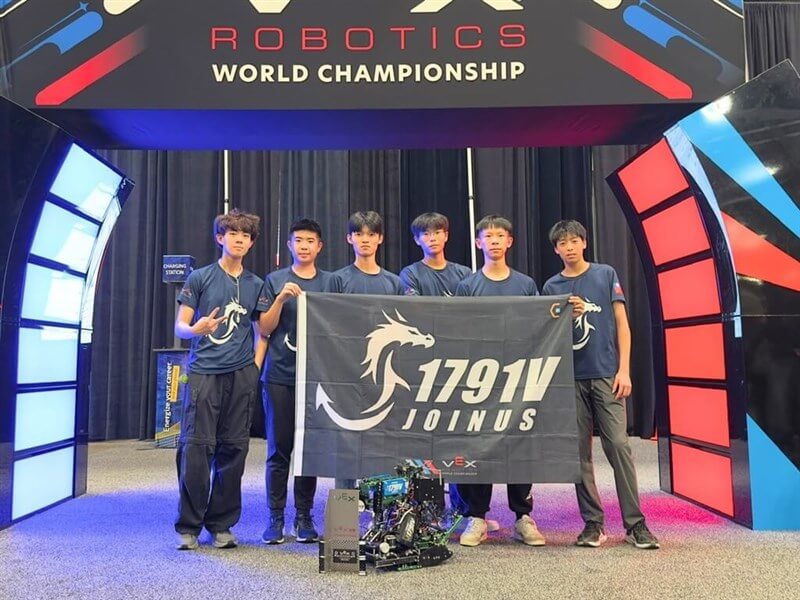
These exist specifically for students whose schools have no strong program. Two of the Bay Area's most accomplished FRC teams — Space Cookies (open to any Bay Area girl) and Peninsula Robotics (open to any Bay Area high school student) — are completely independent of any school. Full details and verified 2026 records are in the table below.
Path 4 — Start Your Own Team
Any adult can register a team ID at firstinspires.org (FLL, FTC, FRC) or robotevents.com (VEX IQ, VEX V5). The league treats a neighborhood team identically to a school team in competition. You need a kit, a workspace, and an adult mentor.
NorCal FLL coordination runs through Playing At Learning, a Fremont-based nonprofit that partners with FIRST to run Northern California FLL tournaments. Their NorCalFLL-Announce Google group is where registration deadlines and tournament information are posted — not through schools.
Bay Area Competition Programs — Verified 2025–26
If you’re evaluating a program based on its actual engineering pipeline, you have to look at the verifiable tournament data from different competitions. In the Bay Area, competitive robotics is local, split between institutional high school clubs and private commercial academies that act like elite club sports teams. T
About the teams in the table:
Team 254 at Bellarmine College Prep won the Silicon Valley District Event, the Central Valley District Event, and the FIRST California Northern State Championship in 2026.
Team 8 at Palo Alto High School won the Contra Costa District Event and the Industrial Design Award, advancing to the State Championship.
Space Cookies (Team 1868) won the Engineering Inspiration Award at both the Silicon Valley District Event and the State Championship. Members attend 21 different Bay Area high schools. Eleven-time Impact Award winners. 100% of alumnae pursue higher education, 85% in STEM. Team page →
Peninsula Robotics (Team 6036) won the Innovation in Control Award at the State Championship. Completely independent — no school affiliation. Open to any Bay Area high school student. Apply at team6036.com →
Monta Vista High School (Team 115) won the Impact Award at the Orange County District Event in 2026. Founded 1998, sponsored by Apple and Intuitive Surgical. mvrt.com →
Dougherty Valley High School VEX has 110+ awards and 12+ World Championship qualifications since 2007. Runs its own annual NorCal VEX tournament and a summer camp open to all Bay Area middle schoolers.
Dublin Robotics Club / Robolabs has multiple VEX Worlds, state, and international wins across FLL, VEX IQ, VEX EDR, and FTC.
Applied Computing Foundation is a nonprofit with wins at the World Robot Olympiad and Congressional App Challenge.
Magikid is a VEX Event Partner with 18 labs worldwide and 12,000 enrolled families.
When Should Your Child Start Competing?
A practical age guide based on program requirements and what coaches actually recommend:
Age eligibility sourced from firstinspires.org and robotevents.com.
The most common mistake: starting at the wrong level. A 9-year-old in a VEX V5 program built for 14-year-olds will be frustrated and quit. A 13-year-old still doing recreational LEGO has missed two to three years of competitive development. One enrichment class before joining a competitive team almost always produces better results than jumping straight in.
Middle School Programs
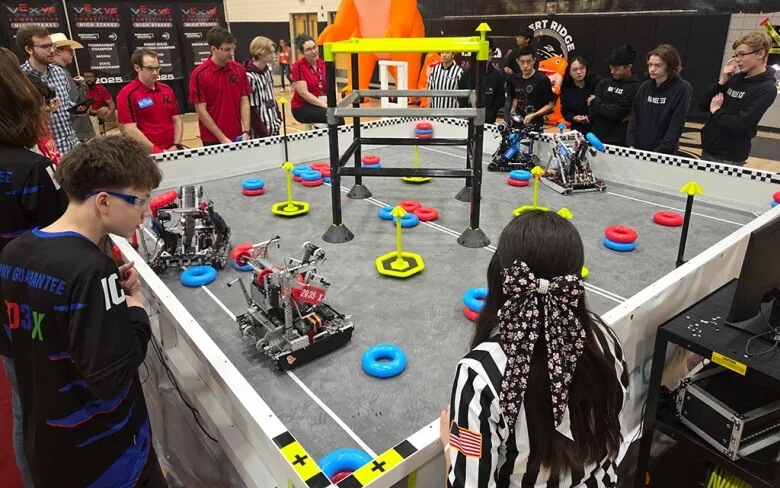
Middle school competitive robotics in the Bay Area is coach-dependent, not school-dependent. The same school can be a state qualifier one year and inactive the next, depending on who's running it.
Public school programs
with consistent track records tend to cluster where active parent booster networks exist — Hopkins Middle (Fremont), JLS and Fletcher (Palo Alto), and Hart Middle (Pleasanton) are frequently cited.
Private schools
with built-in infrastructure — Harker School (San Jose), Challenger School, and Stratford School (Cupertino/Saratoga) — integrate robotics into their curriculum rather than depending on volunteer-run clubs.
The honest reality - A passionate coach can build a state-qualifying FLL team at any school with 10 motivated kids and a field kit. The school name matters far less than who shows up Tuesday afternoon.
Commercial programs
Dublin Robotics Club, Magikid, and Applied Computing Foundation — are often the most reliable middle school competition pathway because they don't depend on any single teacher or school budget. See the table above for verified details.
What Parents Don't Know Until It's Too Late
Competition season has hard deadlines.
VEX registration opens in April-May for the following season.kb.roboticseducation.org
FRC registration opens in spring. FLL NorCal deadlines are distributed through Playing At Learning's Google group, not through schools.playingatlearning.org
Miss those lists and you miss registration.
Expect 6–12 hours per week during season.
Peak season — October through January for FLL and VEX, January through April for FRC — means practices, scrimmages, and tournament days. Regional tournaments can mean driving to Sacramento or further on a Saturday morning.
Parent involvement is often required.
any teams need parents for carpooling, event logistics, and build season mentoring. Space Cookies explicitly requires active parent participation.frc.spacecookies.org
This is a family commitment, not just a child's activity.
Verify every competition claim.
Ask for the current season's active team number. Look it up at RobotEvents.com (VEX) or firstinspires.org (FLL, FRC). Teams graduate, coaches leave, and programs quietly return to enrichment without updating their marketing. Past trophies don't mean current activity.
Where to Go From Here
Browse the complete Bay Area coding and robotics program directory — competition and enrichment tracks, sorted by region and age.
Explore all AIFunLab programs — including AI activities and maker programs that build the foundations competition teams expect.
Find Bay Area STEM events this weekend — including tournaments open to spectators, which are a great way for kids to see competition before committing.
Browse 2026 Bay Area STEM summer camps — many include competition prep tracks for FLL and VEX IQ.
Browse free Bay Area museum and STEM days — low-cost ways to keep kids engaged with science and engineering year-round.
Evaluate Bay Area private schools with active robotics programs and structured STEM pathways built into the curriculum.
If you haven't read Part 1 yet: Coding vs. Robotics vs. Competition Teams: How Bay Area Parents Choose →
Questions Parents Ask
1. How do kids join an FLL team in the Bay Area?
Parents can find active FIRST LEGO League (FLL) teams by zip code via FirstInspires.org. Because Northern California leagues are managed by Playing at Learning in Fremont, families should contact team coaches directly or enroll in independent commercial programs like Dublin Robotics Club to guarantee a roster spot.
2. How do kids join a VEX robotics team in the Bay Area?
Families can locate active regional teams by searching RobotEvents.com by zip code. Open registration for new seasons begins each spring. For students whose schools lack active clubs, commercial academies like Magikid and Robolabs offer immediate team placement and dedicated competition coaching without school district restrictions.
3. What age should kids start competitive youth robotics?
Ages nine to twelve serve as the optimal developmental sweet spot for youth robotics. Official VEX IQ brackets admit students starting at age eight, while FIRST LEGO League eligibility begins at age nine. Completing one introductory enrichment program before entering full competition tracks significantly improves student outcomes.
4. Which Bay Area schools have the best robotics programs?
Bellarmine College Prep (Team 254) and Palo Alto High (Team 8) lead public and private high school FRC divisions. Dougherty Valley High dominates regional VEX V5 circuits. For middle school FLL, public feeders like Hopkins and private academies like Harker and Challenger maintain the top tournament rankings.
5. How do I verify if a robotics program is competition-active?
Request the program's official current-season team identification number from the coordinator. Cross-reference the ID directly on RobotEvents.com for VEX programs or FirstInspires.org for FIRST teams. If the team lacks a paid, active registration for the current calendar year, their competitive claims are obsolete marketing.
Bay Area native, Cal grad. Raising a kid who doesn't sleep easily, which is why we've tried as many sports and camps as we can.

%20(300%20x%20250%20px)%20(1).avif)