
What is the best alternative to a traditional school in the Bay Area?
Nobody leaves a school for one reason.
It's the kid who's bored in math and anxious at lunch. The one who's ahead on paper and miserable in person. The family paying full tuition for a school that still runs on worksheets.
The surveys agree. Stress and anxiety are now the top reason families switch schools, ahead of unmet academic needs and bullying (EdChoice, 2026). A 2026 Christensen Institute study put it bluntly: "what moves families to act isn't aspiration, it's acuity."
What holds parents back is the fear of giving something up: friends, sports, a transcript colleges understand. And in San Francisco, where about 3 in 10 kids already attend private school (KQED), "something different" often means different from the standard prep school, too.
So this guide skips the diagnosis. Every alternative asks you to trade something. Here are the trade-offs Bay Area parents actually weigh, in the words they use: I want this, but not that.
Find your row (most families find two or three)
| I want… | …but not | Start with |
|---|---|---|
| Personal attention | More screens | Fusion Academy, Tilden Prep, Khan Lab |
| Personalized learning | A transcript nobody understands | Khan Lab |
| Independence | Nobody checking the basics | Acton Academy |
| Hands-on projects | Gaps in math and writing | Brightworks; Bay School for high school |
| A calmer school | A lost academic year | Synapse, Millennium, Girls' Middle School |
| Harder work | Being the only kid who wants it | Proof School, Helios, Nueva |
| Sports, orchestra, the works | The pressure cooker | Harker, Nueva, Menlo, Castilleja |
Dyslexia or a diagnosed learning difference? That's a different search: start with our dyslexia and learning differences guide.
“Personal attention, but not more screens”
For the kid who's ahead in one subject and behind in another, or whose skating schedule laughs at an 8-to-3 day.
Look at: one-to-one schools. Fusion Academy (grades 6–12, 11 Bay Area campuses) teaches one student per teacher, priced per course. Tilden Prep (Albany and Walnut Creek) does the same in groups of up to three. If screens don't bother you, Alpha's two-hour adaptive-software morning is the speed option. Just know software is polite: it accepts the right answer and never asks why.
Watch for: friendship becomes your job. Social life moves to club soccer, robotics and youth theater, and you're driving.
Ask: "Where does a one-to-one student practice disagreeing with someone their own age?"
“Personalized, but not a transcript nobody understands”
For the parent who loves self-pacing and lies awake about college applications.
Look at: mastery-based schools. Khan Lab School (TK–12, Palo Alto and Mountain View) moves students on when they show mastery, not when the calendar turns. Teachers do the judging, every student has an advisor, and the transcript is standard.
Watch for: a small pond. About 310 students across 13 grades means a couple dozen kids per grade.
Ask: "Who decided this student mastered fractions? Show me the evidence for one actual kid."
Accreditation, briefly
Mostly in high school. For K–8, California's Private School Affidavit is a registration, not an approval. For grades 9–12, UC approves course lists only from accredited schools; WASC and Cognia both count. Without one, AP, IB or college courses can fill the gap, with more work.
“Independence, but someone still checks the basics”
For the kid who treats "please start your homework" as a declaration of war.
Look at: learner-driven microschools. At Acton Academy (Redwood City, Campbell, Livermore and Concord), kids sign a contract of promises, run their studio and hold each other to it. Guides ask questions instead of handing out answers. Each campus is independently owned, so judge the campus, not the brand.
Watch for: freedom works for kids who use it. And microschools tend to be young: in a 2026 national survey, about one in five had been open six years or more.
Ask: "When a kid falls behind in reading or math, who notices, and what happens that week?"
“Hands-on, but not gaps in math and writing”
For the kid who has disassembled the toaster. Twice.
Look at: project-based schools. Brightworks (K–12, in SF's Presidio, about 115 students) teaches through long interdisciplinary units it calls Arcs, with real tools. For high school, the Bay School (SF) keeps a college-prep core and adds two three-week Immersives a year.
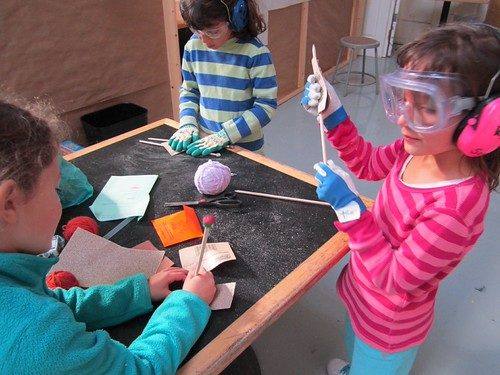
Watch for: the robot is easy to see; the fractions inside it aren't.
Ask: "Pick a recent project and show me where the fractions were."
“A calmer school, but not a lost year”
For the bright kid for whom Sunday nights have become a whole thing.
Look at: wellbeing-first schools. Synapse (preschool–8, Menlo Park) builds social-emotional learning into the core curriculum. Millennium School (SF) was designed for the middle-school years and is adding a grade 5. Girls' Middle School (grades 6–8, Palo Alto) does what the name says.
Watch for: less academic stretch, by design. If a high-pressure high school comes next, the pressure arrives then. For many kids, later is exactly right.
Ask: "When a kid is sliding socially and academically at once, who calls me, and how soon?"
“Harder work, but not being the only kid who wants it”
For the kid who finishes in ten minutes and spends the other forty redesigning the seating chart.
Look at: schools built around strong students. Proof School (grades 6–12, SF) runs about two hours of math a day. Helios (K–8, Sunnyvale) is designed for gifted learners. Nueva (PreK–12, Hillsborough and San Mateo) is the long-established option. Our gifted and advanced guide covers grade-skipping too.
Watch for: faster isn't the same as further. These schools are selective, and the kid who was always fastest in the room may suddenly not be. That's often the point.
Ask: "What happens the first time the work gets genuinely hard for my kid?"
“Sports, orchestra, the works, but not the pressure cooker”
For the family that wants a real gym and a college counselor who has done this a thousand times.
Look at: traditional independent schools. Harker (TK–12, San Jose, nearly 2,000 students), Nueva, Menlo (grades 6–12, Atherton) and Castilleja (girls, grades 6–12, Palo Alto) offer veteran subject teachers, teams, ensembles and counselors with long placement records.
Watch for: less bending. Calendars, grade levels and workload are fixed, and the pressure at the most competitive schools is real.
Ask: "When a strong student starts to buckle, what happens before anyone says 'drop a class'?"
Tuition and full profiles are on our Bay Area private school list.
FAQ
What's the difference between a microschool and a progressive school?
A microschool is defined by size: often a few dozen students or fewer, sometimes in a converted storefront or home. A progressive school is defined by philosophy: hands-on projects, discussion and social-emotional growth over lectures and tests. A school can be both, either or neither, so ask about each separately.
Will my child fall behind at a project-based school?
Not if the school tracks core skills as closely as it showcases projects. The risk is that a finished robot is easy to see while the fractions inside it aren't. Ask admissions to pick a recent project and show where the grade-level math and writing were taught, assessed and recorded.
How do kids at small schools get sports and a social life?
Small schools mean tight peer circles and few teams, so families usually build the rest outside school. Club soccer, robotics, youth theater and city rec programs fill the gaps, and parents do more of the driving. On a tour, ask where students practice disagreeing with kids their own age.
Can my child move back to a traditional school later?
Usually, yes. California private and alternative schools don't need state approval, so the next school decides placement. Public districts may test your child or review work before granting credit, especially in high school. Keep a portfolio of work samples and any test scores, and ask the next school how it places transfer students.
Is Khan Lab School a good fit for a self-paced learner?
Often, yes, especially if you also want a standard transcript. Khan Lab School (TK–12, Palo Alto and Mountain View) moves students on when they show mastery, teachers do the judging, and every student has an advisor. The trade-off is size: about 310 students across 13 grades.
Is Acton Academy worth it?
It can be, for a child who uses freedom well. At Acton Academy (Redwood City, Campbell, Livermore and Concord), kids sign a contract of promises, run their studio and hold each other to it, while guides ask questions instead of handing out answers. Each campus is independently owned, so judge the campus, not the brand.
What nobody says on the tour
You're also choosing classmates. Every tuition check buys a peer group as much as a teaching model. Decide whether that's a draw or a filter for your family.
Small schools are small businesses. At any microschool, ask how many years are left on the lease.
One question works everywhere: "Tell me about the last family that left. Why did they go?" A school that answers honestly, with a real example, knows who it isn't for.
The best school isn't the one with the most impressive philosophy. It's the one whose weaknesses your kid can live with.
Where families go next: Alpha vs Acton vs Khan Lab for the three self-paced models side by side · Bay Area private school list for browsing by region · Gifted and advanced schools · Dyslexia and learning differences · Bilingual and immersion schools



%20(300%20x%20250%20px)%20(1).avif)


-min.avif)

